
If I want the short answer: send LinkedIn messages on Tuesday, Wednesday, or Thursday, usually between 10:00 a.m. and 3:00 p.m. in the recipient’s local time. That’s the safest starting point from the data.
Here’s the article in one view:
- Best days: Tuesday through Thursday
- Best time blocks: 10:00 a.m. to 12:00 p.m. and 1:00 p.m. to 3:00 p.m.
- Monday: fine for connection requests, but not my first pick for a high-stakes DM
- Friday: usable before 2:00 p.m., but weaker for new cold outreach
- Weekend: usually the weakest choice for U.S. B2B messaging
- Avoid: 12:00 a.m. to 7:00 a.m.
- What to track: positive reply rate, time-to-reply, and meeting rate
- How long to test: 2 to 4 weeks
- Big point: timing helps, but message quality still does most of the work
The article also makes one point that matters: the gap between weekday winners is small. So I wouldn’t overthink Tuesday vs. Wednesday. I’d focus first on avoiding weekends, overnight sends, and the wrong time zone.
Here’s a quick view:
| Factor | Best starting point |
|---|---|
| Day | Tuesday to Thursday |
| Time | 10:00 a.m. to 3:00 p.m. |
| Time zone | Recipient’s local time |
| Monday use | Connection requests |
| Friday use | Final follow-ups before 2:00 p.m. |
| Avoid | Weekends and 12:00 a.m. to 7:00 a.m. |
Put simply: if I were building a LinkedIn outreach schedule today, I’d start with mid-week, mid-day, local time, then test against my own reply and meeting data.
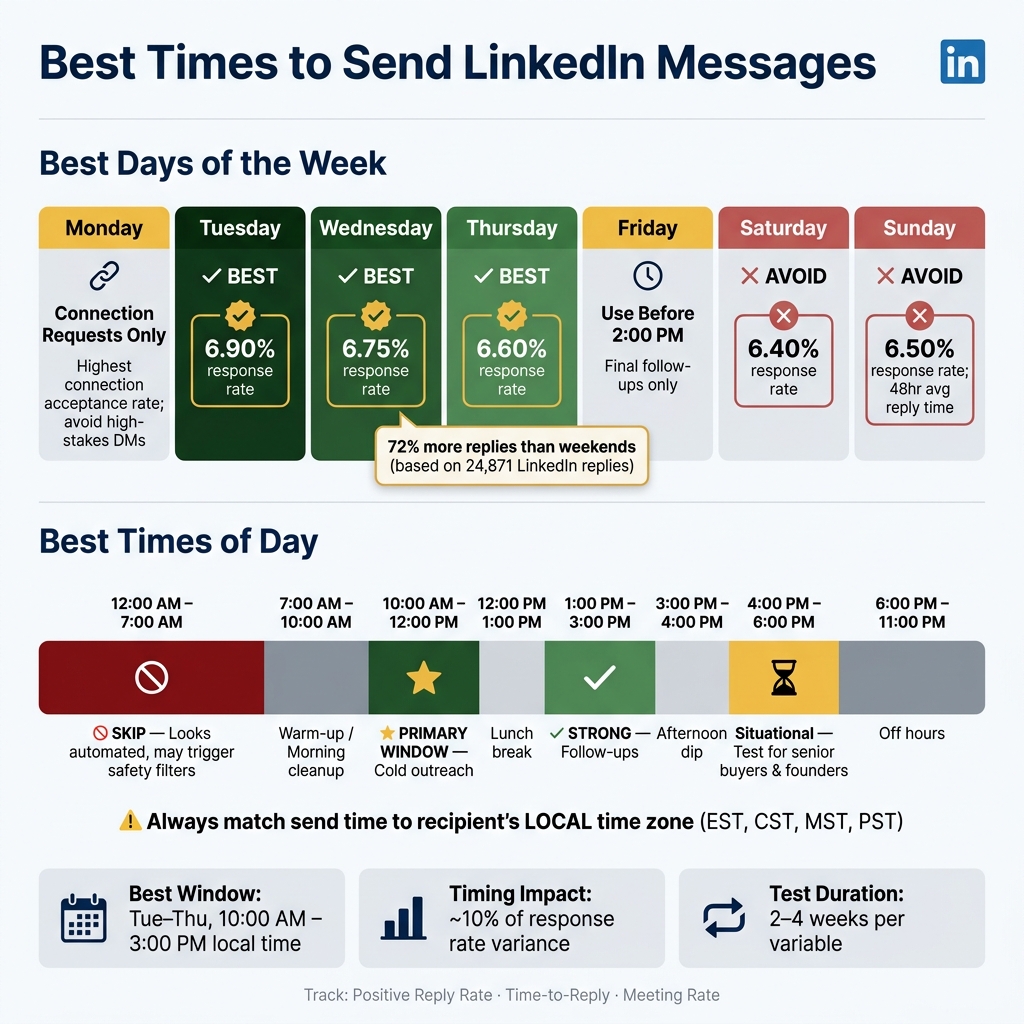
Best Times to Send LinkedIn Messages: Days & Hours Cheat Sheet
SS - 56 - The Best Time To Send DMs On LinkedIn
sbb-itb-f8f3793
Best Days of the Week to Send LinkedIn Messages
Across multiple studies, Tuesday through Thursday stand out as the best days for LinkedIn outreach. Tuesday averages a 6.90% response rate, Wednesday comes in at 6.75%, and Thursday lands at 6.60%. The gap between those three days is small. The big drop happens on weekends and during off-hours.
Why Tuesday Through Thursday Are the Strongest Starting Points
Mid-week tends to work best for a simple reason: people are past the Monday inbox cleanup and not yet in Friday wind-down mode. That makes these days a safer bet for outreach.
Belkins says responsiveness is highest early in the week, when schedules are more structured and fatigue is lower. Spear Outbound found something similar in its 2026 data. Across 24,871 LinkedIn replies, Wednesday produced 72% more replies than Saturday or Sunday.
If you're picking a default send window, this is usually it:
- Tuesday to Thursday for cold outreach
- Tuesday or Wednesday for higher-priority follow-ups
When Monday and Friday Can Still Work
Monday still has a place. It often delivers the highest connection acceptance rate. So instead of writing it off, use it with a bit of timing logic: send the connection request on Monday, then send your pitch or follow-up on Tuesday or Wednesday. That way, the actual message lands in the stronger mid-week window.
Friday is a bit trickier. There’s still some room to work with, but the window is tighter. Engagement drops hard after 2:00 p.m., so Friday late morning or early afternoon can still make sense for final follow-ups. Starting brand-new cold outreach on Friday afternoon, though, is usually a bad bet.
| Day of Week | Research Signal | Recommended Use for LinkedIn Messages |
|---|---|---|
| Monday | Highest connection acceptance rate; mixed reply quality | Connection requests; avoid high-stakes DMs before 10:00 a.m. |
| Tue – Thu | Strongest response window; Tuesday peaks at 6.90%, with Wednesday and Thursday close behind | Primary window for cold outreach and follow-ups |
| Friday | Lower weekday response; drops after 2:00 p.m. | Use for final follow-ups; avoid new cold outreach |
| Saturday | Lowest overall response rate at 6.40% | Generally avoid for standard B2B outreach |
| Sunday | 6.50% response rate; 48-hour average response time vs. 22 hours on weekdays | Avoid for standard B2B outreach; test for early-stage founders |
With the best days locked in, the next piece is time of day.
Best Times of Day to Send LinkedIn Messages
Day of week matters, but time of day still affects response rates. Send at the right hour, and your message has a better shot at being seen instead of buried under everything else. Once you've picked the right days, these are the time slots to test first.
Match every send to the prospect's local time zone. As ProspectZero put it, "A message arriving at 2 PM PST hits the East Coast at 5 PM, which is typically already checked out." If you're doing U.S. outreach across time zones, set separate send windows for EST, CST, MST, and PST.
Top Windows: 10:00 a.m. to 12:00 p.m. and 1:00 p.m. to 3:00 p.m.
The 10:00 a.m. to 12:00 p.m. window is the safest default. By that point, most people are done with morning inbox cleanup and early meetings.
The 1:00 p.m. to 3:00 p.m. window is your next-best option. It often catches prospects between meetings or just after lunch.
Secondary Windows and One Window to Avoid
The 4:00 p.m. to 6:00 p.m. window is worth testing for founders and senior buyers. End-of-day phone checking can create a second bump in engagement, and there may be less inbox competition at that hour. That said, use this as a test window, not your default.
Overnight sends - 12:00 a.m. to 7:00 a.m. - are the one window to avoid entirely. Messages sent during those hours can look like automated LinkedIn lead generation and may trip safety systems. Start with the default windows above, then test other slots only after you have a baseline.
Use these windows as a starting schedule, then track your own reply rate.
| Time block | Recommendation |
|---|---|
| 10:00 a.m. – 12:00 p.m. | Primary window for cold outreach |
| 1:00 p.m. – 3:00 p.m. | Strong secondary for follow-ups |
| 4:00 p.m. – 6:00 p.m. | Situational - test for senior buyers and founders |
| 12:00 a.m. – 7:00 a.m. | Skip |
How to Build a LinkedIn Sending Schedule From This Research
A Simple U.S. Testing Schedule for Cold Outreach and Follow-Ups
Use this schedule as your first test.
Start with a simple baseline: send first-touch messages Tuesday through Thursday, from 10:00 a.m. to 2:00 p.m. local time. Set separate send windows for each recipient time zone. That part matters. A message sent at the right hour in New York can hit at the wrong time in Los Angeles.
Once your first touch is locked in, keep follow-ups in that same general window. Wait 2 to 3 business days before sending the first follow-up. For C-suite leaders and founders, give it more room: 5 to 7 days.
There’s also a useful reality check here: volume has more impact than splitting hairs over Tuesday vs. Wednesday. Accounts sending 10–19 connection requests per day get a 34% acceptance rate. Move up to 20–29 per day, and that rate falls to 30.6%. So keep your daily send volume steady. In plain English, send pace matters more than small day-of-week shifts.
How to Tell Whether Timing Is Actually Improving Replies
After you set a schedule, check whether it’s helping in a way that matters. Raw reply count doesn’t tell the full story. The metrics that give you a better read on timing are positive reply rate, time-to-reply, and meeting rate.
Look at outcome quality, not just reply volume. Run each test for 2 to 4 weeks. Change only one variable at a time, and keep the copy and audience the same. That way, you’re not mixing timing changes with message changes.
If prospects reply faster, there’s a good chance your message hit during an active work block. If your positive reply rate goes up, timing is doing its job.
| Metric | What it tells you |
|---|---|
| Positive reply rate | Are you reaching people who are actually interested? |
| Time-to-reply | Did your message land during an active browsing window? |
| Meeting rate | Is timing supporting real business outcomes? |
Using Postelix to Test Timing Against Real Buyer Intent
Fixed send windows are useful. But live intent signals are often better.
Activity-based timing tends to beat a static schedule: reaching out within 24 hours of a prospect engaging publicly on LinkedIn often performs better than scheduled cold outreach.
Postelix helps you act on that signal. It surfaces prospects showing buying intent, drafts LinkedIn DMs, and syncs your inbox so you can time outreach around real activity.
Conclusion: Start With Mid-Week Business Hours, Then Validate With Your Own Data
Start with Tuesday through Thursday during the recipient’s local mid-morning to early afternoon window. Then check that pattern against your own results.
The difference between the best and worst weekdays is pretty small. So in practice, weekends and off-hours matter more than debating Tuesday vs. Wednesday.
Use these as starting points, not hard rules. Timing explains about 10% of response rate variance, which means personalization and message quality still do most of the heavy lifting, often requiring an intent-led LinkedIn growth strategy to see real results.
The practical takeaway is simple: use mid-week business hours as your baseline, run the test for 2 to 4 weeks, and track positive reply rate and meetings booked - not just raw replies. After that, compare the results with your own data before you treat any pattern like a rule.
FAQs
Should I use the same send time for every time zone?
No. Professional response patterns follow the recipient’s workday, so outreach should match their local time, not yours.
For the best shot at a reply, schedule messages for 8:00 AM–10:00 AM or 4:00 PM–6:00 PM in the recipient’s time zone. If you use your own clock, your message might land overnight or during a slow part of their day.
Do connection requests and DMs work best at different times?
Yes. Connection requests and DMs tend to do best at about the same times: Tuesday through Thursday, ideally between 8:00 AM and 11:00 AM in the recipient’s local time zone.
The main difference comes down to timing. Mid-week connection requests are more likely to get accepted fast, which gives you a good window to follow up while the person is still paying attention. If someone accepts your request on Friday, that momentum often drops off.
How do I know if timing is improving my LinkedIn results?
Don’t just track raw response volume. Look at response rates, click-throughs, and how fast prospects reply.
Then compare those numbers across different days and time blocks. That’s how you spot patterns in when your audience is most active.
If your timing is getting better, the signs should show up pretty clearly: more positive replies, faster response times, and stronger downstream results like meetings booked.