
Want your LinkedIn comments to stand out and get noticed? Here's how:
- Engage deeply with posts: Read the full post, not just the headline. Reference specific details to show genuine interest.
- Share your experience: Add value by contributing personal insights, examples, or relevant data.
- Ask meaningful questions: End with specific, open-ended questions to spark further discussion.
- Avoid generic comments: Skip empty praise like "Great post!" or self-promotional remarks.
- Be concise: Keep comments to 2–4 sentences for clarity and readability.
Key takeaway: Thoughtful comments that add value and encourage dialogue can increase your LinkedIn visibility, profile visits, and connection requests.
Full Guide to Engaging & Commenting on LinkedIn (Best Growth Strategy)
sbb-itb-f8f3793
Core Principles for Writing Comments That Get Responses
Before jumping into specific strategies, it’s key to grasp what makes some comments spark conversations while others fade into the background. It boils down to three main principles that influence both how people and LinkedIn’s algorithm react to your comment.
Write in Your Natural Voice
Think of your comment as a casual chat with a colleague. Writing in a way that feels natural makes your comment more relatable and genuine. Want to test it? Read it out loud before posting. If it feels stiff or overly formal, it’s time for a rewrite.
Personal touches go a long way in building trust. Using phrases like “In my experience…” or “When we tried this…” makes your comment feel grounded and sincere. It shows you’re sharing something real, not just tossing out generic advice. This kind of tone helps avoid sounding rehearsed or robotic.
Add Something Useful to the Discussion
Comments like “Great post!” might feel polite, but they rarely lead to meaningful engagement. In fact, about 80% of LinkedIn comments fall into this “empty praise” category, and they don’t add much value to the conversation.
Instead, aim to contribute something specific. Share a personal story, provide a relevant statistic, offer a counterpoint, or introduce a fresh perspective. Referencing a detail from the original post shows you’ve actually engaged with the content. A strong comment acknowledges a specific idea, brings in new insight or experience, and wraps up with an open-ended question to keep the dialogue going.
Skip Generic and Self-Promotional Comments
Nothing derails a conversation faster than self-promotion. Comments like “DM me for details” or dropping links to your services often come across as spammy. Not only do they erode trust, but LinkedIn’s algorithm may also flag them as low-quality, pushing your comment further down the thread.
| Comment Style | Impact on Engagement | Why It Works or Fails |
|---|---|---|
| Natural/Authentic | High | Builds trust, feels human, and sparks real conversations |
| Corporate/Polished | Low | Comes off as scripted and lacks a personal touch |
| Generic/Filler | Minimal | Shows little effort and is often ignored by the algorithm |
| Self-Promotional | Negative | Damages trust and may lead to being ignored or blocked |
Adopt a “value first” mindset. Focus on sharing insights and engaging meaningfully for months before even considering self-promotion. And when you do, make sure it’s directly tied to the topic at hand.
How to Write LinkedIn Comments That Get Responses
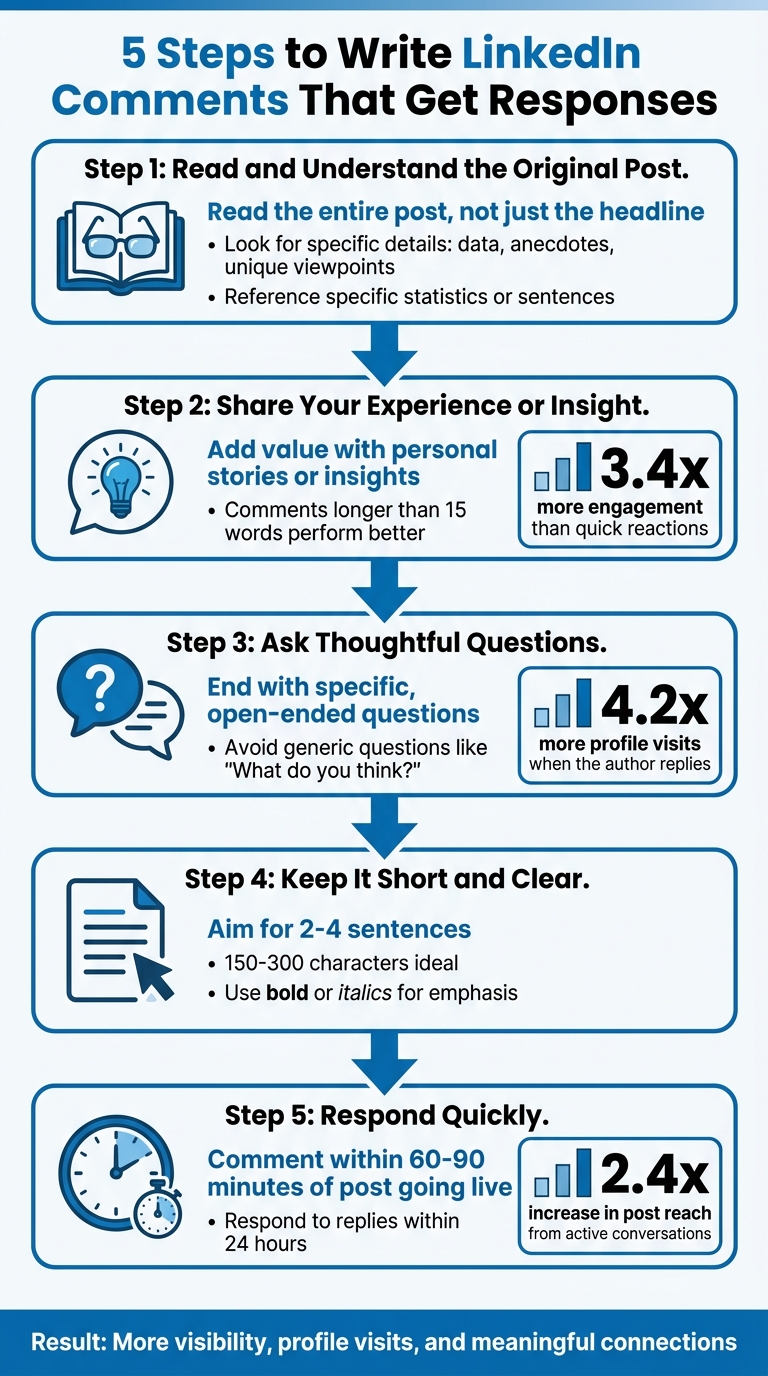
5-Step Process for Writing LinkedIn Comments That Get Responses
Now that you’re familiar with the basics, let’s break it down into actionable steps for crafting LinkedIn comments that spark meaningful engagement. These five steps will help you stand out and encourage responses.
Step 1: Read and Understand the Original Post
Don’t just skim the headline - take the time to read the entire post. This helps you fully grasp the author’s message and context. Look for specific details like data, anecdotes, or unique viewpoints that you can reference in your comment. Noticing whether the tone is reflective or analytical can also guide how you respond. For example, referencing a specific statistic or sentence shows the author you’ve truly engaged with their content.
Step 2: Share Your Experience or Insight
Think of your comment as a mini-contribution to the conversation. Add value by sharing a relevant personal story or insight that ties into the post. For instance, if someone discusses challenges in remote work, you might share how your team overcame similar hurdles. Comments longer than 15 words tend to perform better, generating 3.4 times more engagement than quick reactions or emojis.
Step 3: Ask Thoughtful Questions
Wrap up your comment with an open-ended question to encourage dialogue. Avoid generic or rhetorical questions like “What do you think?” Instead, ask something specific and engaging, such as: “Which approach has been more effective for you: Option A or Option B?” or “When you mentioned [quoted phrase], were you referring to [interpretation A] or [interpretation B]?” These types of questions invite deeper interaction. Comments that earn replies from the original poster can lead to 4.2 times more profile visits for the commenter.
Step 4: Keep It Short and Clear
Aim for comments that are 2–4 sentences long, or about 150–300 characters. This strikes a balance between being concise and adding value. Short comments are easier to read, especially on mobile devices. Use simple formatting like bold or italics to emphasize key points, but avoid overdoing it.
Step 5: Respond Quickly to Keep the Conversation Alive
Once you’ve posted your comment, timing becomes crucial. The best time to comment for maximum visibility is within 60–90 minutes of the post going live. Engaging early boosts your chances of being noticed by both the author and other readers. If someone replies to your comment, keep the momentum going by responding within 24 hours. Active conversations in the comments can increase a post’s reach by up to 2.4 times.
LinkedIn Comment Examples That Work
Effective comments on LinkedIn go beyond the surface. They engage meaningfully, adding value and sparking conversation. Below are some examples that show how to apply these principles in real scenarios.
Example 1: Responding to Industry News
When someone posts about changes or trends in the industry, the "Extension" framework can help you craft a thoughtful response. This approach involves building on the original post with additional insights or experiences.
Original Post: "Google's latest algorithm update has made bounce rate less reliable as a performance metric."
Effective Comment: "The point about bounce rate being unreliable post-update is spot on. We've shifted to tracking time-to-conversion instead, which minimized irrelevant data. Have you seen similar shifts in other verticals?"
Why it works: This comment shows you’ve read and understood the post, shares a practical alternative based on real-world experience, and ends with a question to encourage further discussion.
Example 2: Celebrating Someone's Achievement
A simple "Congrats!" often gets lost in the noise. Instead, try "Supportive Amplification", where you highlight specific details that others might miss.
Original Post: "Just completed my first marathon after six months of training!"
Effective Comment: "Congrats, Sarah. Notably, persisting through winter training - a challenge where most falter - demonstrates exceptional resilience. The discipline you built here translates directly to long-term projects. Well earned."
Why it works: By mentioning the person's name, acknowledging a unique challenge (winter training), and connecting it to broader qualities like resilience and discipline, this comment feels personal and thoughtful.
Example 3: Contributing to Professional Insights
When engaging with thought leadership posts, the "Acknowledge-Insight-Question" formula is a great tool. This involves referencing a specific point, adding your expertise, and closing with an open-ended question.
Original Post: "Hiring in cohorts rather than one-by-one has transformed our onboarding process."
Effective Comment: "Your point about hiring in cohorts is critical. One nuance I'd add: timing matters as much as batch size. Switching from monthly to quarterly cohorts reduced our onboarding time by 40%. How did you handle cultural dilution as you scaled?"
Why it works: This comment adds a concrete example (40% reduction in onboarding time), expands on the original idea, and invites further conversation with a targeted question. Comments like this often lead to replies, which can boost your profile visibility by 4.2 times.
Using Postelix to Improve Your LinkedIn Comments
Postelix is a Taplio alternative for LinkedIn lead generation that simplifies the process of creating impactful comments, making it easier to implement strategies that drive engagement.
Writing thoughtful, personalized comments can take a lot of time. Postelix uses AI to draft responses that feel genuine and tailored, leaving you to review and refine them before posting.
Postelix Features for Better Comments
Postelix goes beyond surface-level commenting by analyzing the full context of LinkedIn posts. It considers the author’s tone, key points, and even attached media, like PDFs or carousels, to generate relevant and meaningful responses. The platform also supports "Strategic Commenting", helping you focus on a curated list of accounts: 25% potential clients, 25% influencers, and 25% partners. It even tracks your interaction history to ensure you don’t repeat yourself.
With its Chrome extension, Postelix integrates seamlessly into LinkedIn, identifying top posts from your target accounts and suggesting real-time commenting opportunities. One user reported a 10x boost in commenting activity after incorporating these tools into their routine. The AI drafts comments that reflect your unique voice and include engaging questions, giving you a solid foundation to tweak before posting.
Postelix doesn’t stop at individual comments - it manages your entire engagement strategy. It finds high-value posts, generates thoughtful comments, and can even initiate direct messages to help turn connections into opportunities. This targeted approach saves time while maximizing the impact of your engagement, helping you gain visibility and spark meaningful conversations.
Selecting the Right Postelix Plan
Postelix offers three plans tailored to different needs:
- Starter Plan ($31/month): Includes 60 AI-generated comments per month and voice profile customization. Ideal for building a consistent commenting habit.
- Growth Plan ($79/month): Provides 150 AI comments monthly, daily suggested leads, and a Direct Message Assistant to turn comment interactions into deeper connections.
- Pipeline Plan ($199/month): Designed for serious pipeline generation, offering 300 AI comments per month, a 24/7 Hot Lead Agent to monitor up to 10 competitor accounts and 10 intent keywords, and delivering 25-50 intent leads daily - helping you identify interested buyers before your competitors.
With these tools, Postelix helps you align your LinkedIn activity with your broader engagement and business goals.
Conclusion
Crafting LinkedIn comments that spark responses boils down to being helpful and thoughtful. The best comments highlight a specific detail from the original post, share a personal insight or experience, and wrap up with a genuine question to encourage dialogue. This approach works because it shows you’ve truly engaged with the content and have something meaningful to add.
Timing makes a big difference, too. The first 60–90 minutes after a post is published is your prime opportunity to maximize visibility. By consistently leaving insightful comments, you’re not just participating in conversations - you’re establishing yourself as a credible voice in your industry.
"The LinkedIn algorithm rewards conversation, not broadcasting. The more genuine replies your post generates, the wider it travels." – Richard van der Blom, LinkedIn Algorithm Researcher
To keep up with this level of engagement, using a specialized tool can save you a lot of time. Tools like Postelix handle repetitive tasks, such as finding relevant posts, understanding their context, and drafting tailored responses that reflect your style. Whether you’re starting small with the Starter Plan or scaling up with the Pipeline Plan’s 300 monthly AI comments and 24/7 Hot Lead Agent, the aim stays the same: turn LinkedIn interactions into meaningful professional connections.
Why not begin today? Write one thoughtful comment - mention a specific point, add your perspective, and ask a question. The connections will come naturally.
FAQs
How do I sound authentic without oversharing?
To strike the right balance on LinkedIn, aim to share insightful thoughts and relevant experiences rather than diving into overly personal details. For example, when engaging with a post, reference specific points, provide meaningful context, or pose thoughtful questions to show you're genuinely interested. Keep your comments short and impactful - just 2-4 sentences is enough. Avoid generic responses like "Great post!" as they add little value. This way, you can showcase your expertise and authenticity without oversharing.
What’s a good comment template I can reuse?
A well-crafted LinkedIn comment can make all the difference in fostering connections and meaningful conversations. Here's a simple structure to follow:
"Great post! I completely agree with [specific point] and wanted to add [your additional insight]. How do you see this evolving in the next few months?"
This format works because it does three things: it acknowledges the original post, contributes your own perspective, and ends with a question to spark further discussion. It's a small effort that can lead to big engagement.
How do I turn comment replies into new connections?
To transform comment replies into meaningful connections, aim for genuine interactions. Respond in a way that adds value - ask open-ended questions, share your own relevant experiences, or expand on the original idea. This approach demonstrates real interest and helps build rapport. When you engage consistently and thoughtfully, these conversations can naturally evolve into direct messages or even connection requests. Remember, authenticity and personalization are crucial for turning casual exchanges into lasting professional relationships.