
Most teams know competitor analysis matters, but few turn it into more replies, better comments, and more pipeline. The fix is simple: I keep a small LinkedIn watchlist, track buyer words from competitor profiles, comments, job posts, and search autocomplete, then sort those terms by intent and use them in DMs, comments, and posts.
Here’s the short version:
- Start small: track 5–10 competitors and 3–5 buyer personas
- Pull words from LinkedIn itself: profiles, company pages, comments, job posts, and autocomplete
- Sort terms by job: positioning, outcomes, features, objections, and buying intent
- Focus on action, not volume: Tier A for DMs/comments, Tier B for posts, Tier C for monitoring
- Watch for shifts: new terms, dropped terms, and hiring language can hint at market moves months early
- Review on a set rhythm: weekly scan, monthly performance check, quarterly cleanup
A few numbers make the case. 84% of marketers say competitive analysis matters, but only 29% trust their own findings. And when teams act on clear competitor intel, sales win rates can improve by 10%–15% within six months.
What I take from that is simple: this is not SEO keyword research. It’s a LinkedIn language system for finding the words buyers use when they’re close to a problem, close to a change, or close to a buying decision.
If I were summarizing the whole article in one line, it would be this:
Use buyer language from LinkedIn to write messages people answer.
The article breaks that into a clear process:
- define a tight competitor and ICP scope
- build a keyword watchlist from the right places
- rank terms by intent, fit, and white-space value
- apply those terms to outreach without sounding stiff
- track what leads to replies, conversations, and meetings
Done well, this stays light and repeatable. That matters, because more than 70% of teams that run fully manual competitor tracking stop within 3 months.
So the goal isn’t to build a giant spreadsheet.
The goal is to keep a short list of words that help you start better sales conversations on LinkedIn.
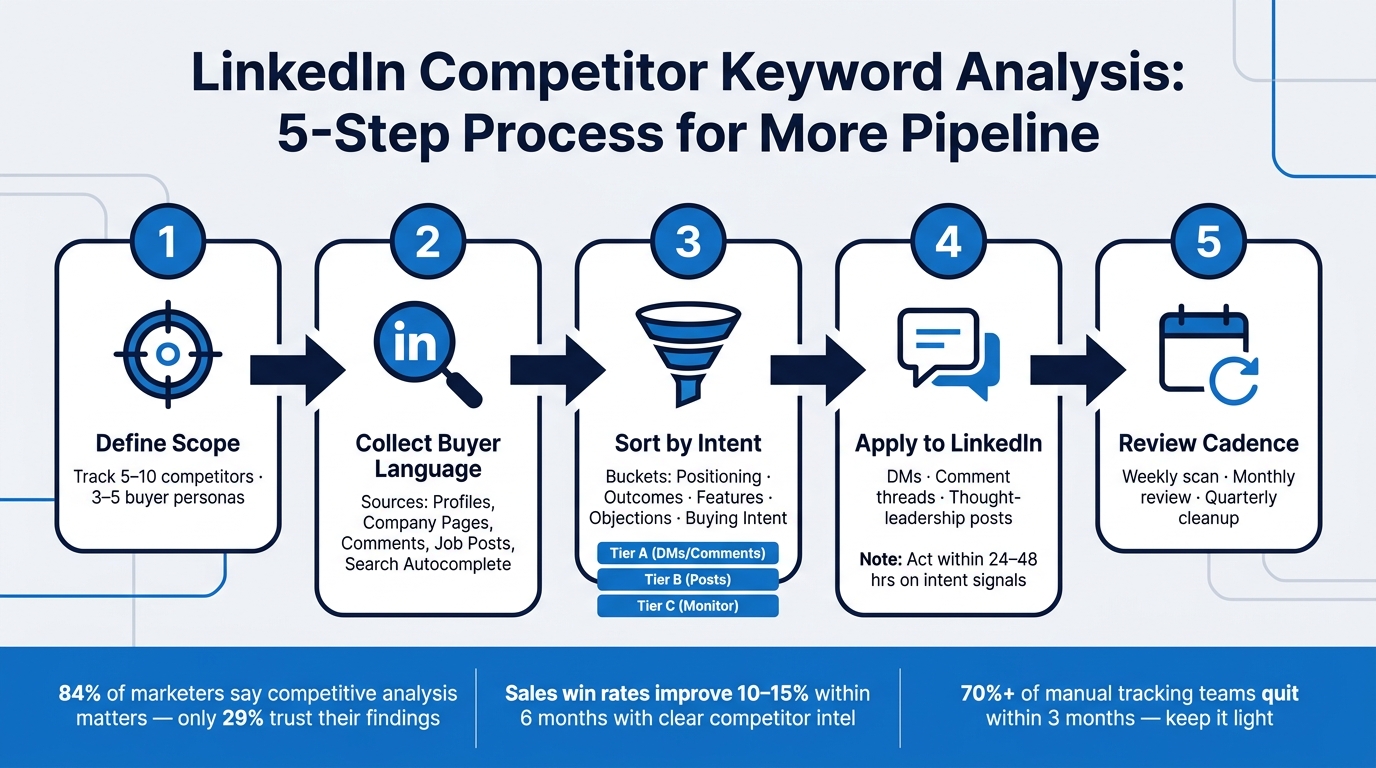
LinkedIn Competitor Keyword Analysis: 5-Step Process for More Pipeline
Build a LinkedIn Keyword Watchlist From the Right Sources
Start with LinkedIn sources in this order: profiles, comments, job posts, and autocomplete.
Pull Language From Competitor Profiles and Company Pages
Headlines and About sections usually carry the clearest positioning language. In many cases, executive and sales leader profiles show messier, more direct messaging than company pages. That can be useful. Company pages often sound polished, while personal profiles tend to reveal how people in the market talk when they’re not sanding every edge off.
Pull outcome language from Featured. Then pull feature or methodology terms from Skills, Specialties, and Experience.
After that, shift from company-led language to what buyers are saying in public through comments and job posts.
Mine Posts, Comments, and Job Descriptions for Real Market Language
Prioritize comments from C-suite and VP buyers for strategic buying language, especially questions, objections, and feature requests. This is often where you’ll see the gap between what vendors say and what buyers care about.
Use job descriptions to spot investment shifts before product updates go public. If a company starts hiring around a new function, toolset, or workflow, that can hint at where its budget and plans are headed.
Use search autocomplete or compare LinkedIn growth tools to find common phrasing and keyword variations buyers actually use. It’s a simple source, but it often surfaces the exact wording people type when they’re in research mode.
Separate Profile, Content, Engagement, and Intent Keywords
Separate keywords by source and intent. A flat list gets messy fast and is harder to act on.
Once you collect the language, sort it by function before you use it. You can then find post angles based on these keywords to reach your target audience.
| Keyword Bucket | Where to Find It | What It Tells You |
|---|---|---|
| Positioning | Competitor headlines, About sections | How they frame their category and value |
| Outcomes | Featured content, case studies | The results and proof points they promise |
| Features | Skills, specialties, experience sections | Technical language and methodologies in the market |
| Objections | Comment threads, post replies | What buyers dislike about current solutions |
| Buying Intent | Search autocomplete, recommendation posts, job descriptions | Active research and strategic shifts |
Intent keywords need extra attention. Phrases like "evaluating," "pilot," or "looking for recommendations" can show up when a buyer is actively in market. Those signals fade fast, so acting within 24-48 hours of spotting them is critical for outreach.
Keep intent terms in their own column. If you mix them into positioning or feature language, the best outreach signals can slip past you.
sbb-itb-f8f3793
Prioritize the Keywords That Actually Move Revenue Conversations
Prioritize keywords by actionability, not list size. The goal here isn't to build a giant keyword database. It's to figure out which terms are worth using in DMs, comments, and posts.
Once you rank the list, each tier can line up with a different LinkedIn move.
Rank Keywords by Intent, ICP Fit, and Differentiation Value
A simple three-tier model keeps this easy to run.
- Tier A: high-intent, ICP-fit terms for DMs and comments
- Tier B: trend and category terms for posts and threads
- Tier C: brand-specific competitor terms and broad industry jargon to monitor
The differentiation filter matters more than most teams think. If every competitor in your space is already saying "AI-powered automation," adding that phrase to your DMs won't help you stand out. It just makes you sound like everyone else. A better move is to find buyer topics competitors haven't crowded yet. That's where your language has a better shot of landing.
Score each keyword on ICP relevance, LinkedIn signal strength, and differentiation value. For example, "supply chain analytics" aimed at a manufacturing ICP might score a 90: high relevance, lower competition. "Digital transformation" might score a 60 because it's broad and crowded, which makes focused conversations harder to start. Use the log to keep Tier A terms current as buyer language shifts.
Keep a Change Log to Spot Shifts in Competitor Messaging
Ranking alone isn't enough. Competitor language moves fast. A shift from "leads" to "pipeline" or from "automation" to "orchestration" can point to a new market narrative. If you're paying attention, you can catch that change before it shows up in launch copy.
Track two things in particular:
- terms competitors add during launches
- terms they stop using
A spike in hiring posts around a new function, like "AI Product Manager," can hint at keyword and messaging shifts 3–6 months before those terms appear in public launch materials. Each time you spot a change, log the date, source, and context. Over time, that record shows which terms are gaining traction and which ones are fading.
Apply Competitor Keywords to DMs, Comments, and Posts Without Losing Your Voice
Start with your Tier A intent terms. Use them in DMs, comments, and posts, because those are the places where buyers already respond.
Use Buyer-Language Keywords to Sharpen LinkedIn DMs
Pull DM hooks from buyer comments. That’s where people spell out what’s bothering them: implementation problems, data silos, integration issues, and all the messy stuff polished messaging tends to smooth over. Those phrases work much better than brand-approved positioning lines.
Take the pain points that come up again and again, and turn them into a problem-led opener. Lead with the issue, not the thread itself. If someone was asking questions in a discussion about data integration silos, your opener should be about data integration silos.
That same language works in public conversations too, especially where buyers are already active.
Join Comment Threads to Get in Front of In-Market Buyers
Keep an eye on threads where your ICP is already talking. If you join with something useful - not a pitch - you put yourself in front of buyers who are already thinking about the problem you solve.
A good comment usually does one small thing well:
- Clarifies a term
- Answers a question no one answered
- Adds a practical point
Look for gaps in the thread. Maybe a competitor made a big claim but skipped the "how." Maybe people asked follow-up questions and got nothing back. That’s your opening. Use the same words the thread is already using. That’s what makes your comment feel on-topic instead of dropped in from nowhere.
Once you spot the phrases buyers lean on, use them as the base for your posts.
Build Thought-Leadership Posts Around Market Vocabulary, Then Add Your Own Angle
Start with the market problem people already know, then add your take. If your ICP keeps coming back to a phrase like revenue operations alignment, use that as the entry point - not the final point. A post gets attention by naming something familiar. It earns trust when you say something specific that competitors didn’t.
Your own experience is what sets the post apart. Text-only posts with first-hand stories from executives can beat polished corporate videos by 3–5x in meaningful comments.
"A true content gap often exists at the intersection of 'what your audience needs to know' and 'what your competitors aren't providing effectively or at all.'" - Kaelen Schmidt, SEO Strategist
Use the market’s language, but keep your tone natural. The buyer phrases you pull from competitor analysis should shape how you frame the post, not take over how you sound. Market vocabulary helps people recognize the topic. Your point of view is what makes them stay with it.
Set Up a Simple Review Cadence to Keep the Process Running
Once your keyword tiers are in place, you need a rhythm to keep them useful. Without a review loop, your watchlist gets old fast.
Track Reply Rates, Comment Engagement, and Pipeline Signals by Keyword Tier
Track the signals that lead to replies, comments, and meetings. For intent keywords, focus on DM reply rate, positive response rate, and qualified conversations started. Those numbers show whether your outreach is opening doors or just making noise.
For engagement and topic keywords, look past surface-level activity. The main thing to watch is substantive replies. Are buyers asking follow-up questions? Are they adding context? Or are you just getting generic praise? A like-to-comment ratio above 20:1 often points to weak interest.
Break results out by persona, seniority, and industry. One keyword cluster may land well with one group and miss with another. That gap can tell you a lot about your messaging and your ICP targeting.
Run a Weekly Scan, Monthly Review, and Quarterly Cleanup
Use the same Tier A/B/C list from the prior section to decide what gets checked and when.
| Cadence | Task | Goal |
|---|---|---|
| Weekly | Scan competitor posts and job ads | Catch new market language and engagement spikes |
| Monthly | Review DM and comment performance | Align messaging with keywords that move pipeline |
| Quarterly | Keyword list cleanup | Retire stale phrases; promote high-performing intent terms |
Job posts are often the fastest early signal. If a company starts hiring for roles like "AI Product Manager," that can hint at a strategic push 3–6 months before the same language shows up in launch copy.
Use Postelix to Monitor Intent Keywords and Keep Execution in Your Own Voice
If you want to cut down on manual work, a tool can help here.
Postelix can monitor keywords, surface comment opportunities with high upside, draft DMs and posts in your voice, and sync your inbox. You still approve every message before it goes out.
Conclusion: Keep the Process Narrow, Practical, and Consistent
LinkedIn competitor keyword analysis works best when you keep the process tight. The teams that do well focus on the terms that spark conversations, then track them on a steady rhythm. That’s how the language on your list turns into replies, comments, and pipeline.
The process itself is straightforward: focus on a small group of direct competitors and key buyers, collect buyer language, sort it by intent, and put it to work in outreach.
There’s a good reason to keep it light. Over 70% of teams that start a purely manual competitive analysis process abandon it within 3 months due to burnout and tedious data entry. More effort isn’t the answer. A simpler, steadier cadence is.
Put this on the calendar and keep it there:
- One weekly scan
- One monthly review
- One quarterly cleanup
That’s enough to keep your list current without turning the work into a drag.
The goal is simple: use buyer language to earn better replies, stronger engagement, and more pipeline - one useful message at a time.
FAQs
How do I choose the right LinkedIn profiles to track?
Use a tiered approach to balance direct, adjacent, and aspirational peers:
- Tier 1: direct competitors going after the same deals
- Tier 2: indirect players solving similar problems
- Tier 3: aspirational industry leaders
Track both company pages and key individuals, such as founders, sales and marketing leaders, and product leads. Focus first on the profiles and voices that shape how your audience thinks, even when those people sell something different.
What counts as a high-intent keyword on LinkedIn?
High-intent keywords on LinkedIn are phrases that show someone is dealing with a problem right now or looking into a fix.
They usually fit into three buckets:
- Pain-based phrases, like "struggling with [problem]"
- Recommendation requests, like "looking for alternatives to [competitor]"
- Competitor-related terms, like "switching from [competitor]"
These signals matter because they often point to people who are already in research mode, not just casually browsing.
Postelix helps you track those intent signals and turn LinkedIn activity into pipeline.
How long should I test keywords before changing them?
Monitor competitor content for 30 to 60 days before changing keywords. That window gives you enough time to filter out short-term algorithm noise and gather data you can actually use.
It also helps you spot emerging trends, seasonal shifts, and language patterns that connect with your audience.