Most LinkedIn traffic won’t convert on the first visit. If 97% of first-time visitors leave without taking action and B2B buyers need 7–8+ touchpoints, the fix is simple: stop sending the same message to everyone.
I’d sum it up like this:
- Retarget by behavior, not just page visits
- Match the next ad to the last action
- Use soft offers early and direct CTAs later
- Treat pricing-page visits, demo-page visits, and form opens as high-intent signals
- Measure movement to the next funnel step, not just clicks
In plain English, LinkedIn retargeting works best when I split audiences by intent signals:
- Early stage: blog readers, ad clickers, 25% video viewers
→ show guides, education, and problem-focused content - Mid stage: solution-page visitors, 50–75% video viewers
→ show case studies, ROI content, and product proof - Late stage: pricing-page visitors, demo-page abandoners, lead form openers, 75%+ video viewers
→ show demos, trials, testimonials, and low-friction offers
A few numbers make the case clear:
- 75% video viewers can convert around 6.2% for demo requests
- Pricing-page retargeting can convert around 4.7%
- Generic site visitor retargeting may convert closer to 1.9%
- High-intent follow-up often works best within 7–14 days
- Lower-intent nurture windows can stretch to 60–90 days
What matters most is funnel movement. I’d look at whether someone went from a blog post to a pricing page, from a pricing page to a demo, and from a demo to pipeline.
This article explains how to build that path with simple stage-based retargeting on LinkedIn.
Why LinkedIn Ads Are Actually a Pyramid - The Full Funnel Strategy
sbb-itb-f8f3793
How LinkedIn Retargeting Solves Funnel Stalls
LinkedIn retargeting lets you turn past engagement into separate audiences and then show each group the next message that fits. Instead of serving the same ad to everyone who visited your site, you split people up by what they actually did: watched a video, clicked an ad, opened a lead form, or visited a certain page.
Each action tells you something about where that person is in the buying journey.
Retargeting audiences map to awareness, consideration, and decision
Not every engagement signal means the same thing. Someone who watched 25% of a video is still early. Someone who visited your pricing page is sizing you up. If you treat those two people the same way, you burn budget and slow the path to conversion.
Use this map:
| Funnel Stage | Engagement Signal | Recommended Next Step |
|---|---|---|
| Awareness | 25% video view, blog visit, ad click | Educational guides, playbooks |
| Consideration | 50–75% video view, solution page visit | Case studies, ROI calculators, comparison guides |
| Decision | 75–97% video view, pricing/demo page visit | Direct demo offer, free trial, risk-reversal offers |
As intent goes up, your message should shift too. Start with education. Then move to proof. Then ask for action. That change in message is what helps move prospects closer to conversion.
Lead form behavior is one of the clearest signs that someone is close to a decision. If a person opened your form but didn’t submit it, they paused. That hesitation still signals intent. In plain English, they were interested enough to start, but something stopped them.
That’s when objection-handling content makes sense, like:
- Testimonials
- Simpler offers
- “No credit card required”
A form opener is not just a lead. It’s a buyer who has already crossed the first intent threshold.
Progression happens when the next message matches the last action
The rule is simple: match the next message to the last action.
A thought-leadership viewer needs more education. A 75% video viewer is much closer to a decision and is ready for a direct CTA. Prospects who watch 75% of a video ad convert at about 6.2% for demo requests because, by that point, they’ve already done much of the evaluation work. Push a hard pitch too early, and you create friction instead of momentum.
Signals That Show a Prospect Is Ready to Move Forward
Use intent signals to decide who gets the next message.
Engagement signals from LinkedIn content and ads
Not every click means the same thing. Some people are just browsing. Others are much closer to taking action.
On LinkedIn, one of the clearest signs is video engagement. Prospects who watch 75% of a video ad convert at 6.2% for demo requests. That’s a strong clue they’re paying attention.
Form openers matter too. If someone opens a form but doesn’t finish it, that often points to intent held back by friction. In plain English: they were interested, but something got in the way. A simpler offer can work better in that case.
These signals help you sort people into the right path:
- Lighter engagement = keep them in nurture
- Stronger engagement = move them to a stronger offer
High-intent website actions that justify direct follow-up
A site visit on its own doesn’t tell you much. The page matters more than the visit itself.
Pricing, demo request, and contact form pages are the clearest buying signals. Those actions can justify direct follow-up. Someone looking at pricing is not behaving like a casual reader.
The numbers back that up. Retargeting pricing page visitors can convert at 4.7%, compared with 1.9% for generic website visitors. That gap is hard to ignore.
Timing matters just as much as the action. High-intent signals have a short shelf life. A pricing page visit should trigger follow-up within 7 to 14 days if you want to stay relevant. General blog readers, on the other hand, can stay in a nurture window of 60 to 90 days.
That split between high intent and lighter interest sets up the next step: a simple retargeting structure for each funnel stage.
A Simple Retargeting Structure for Moving Buyers Through the Funnel
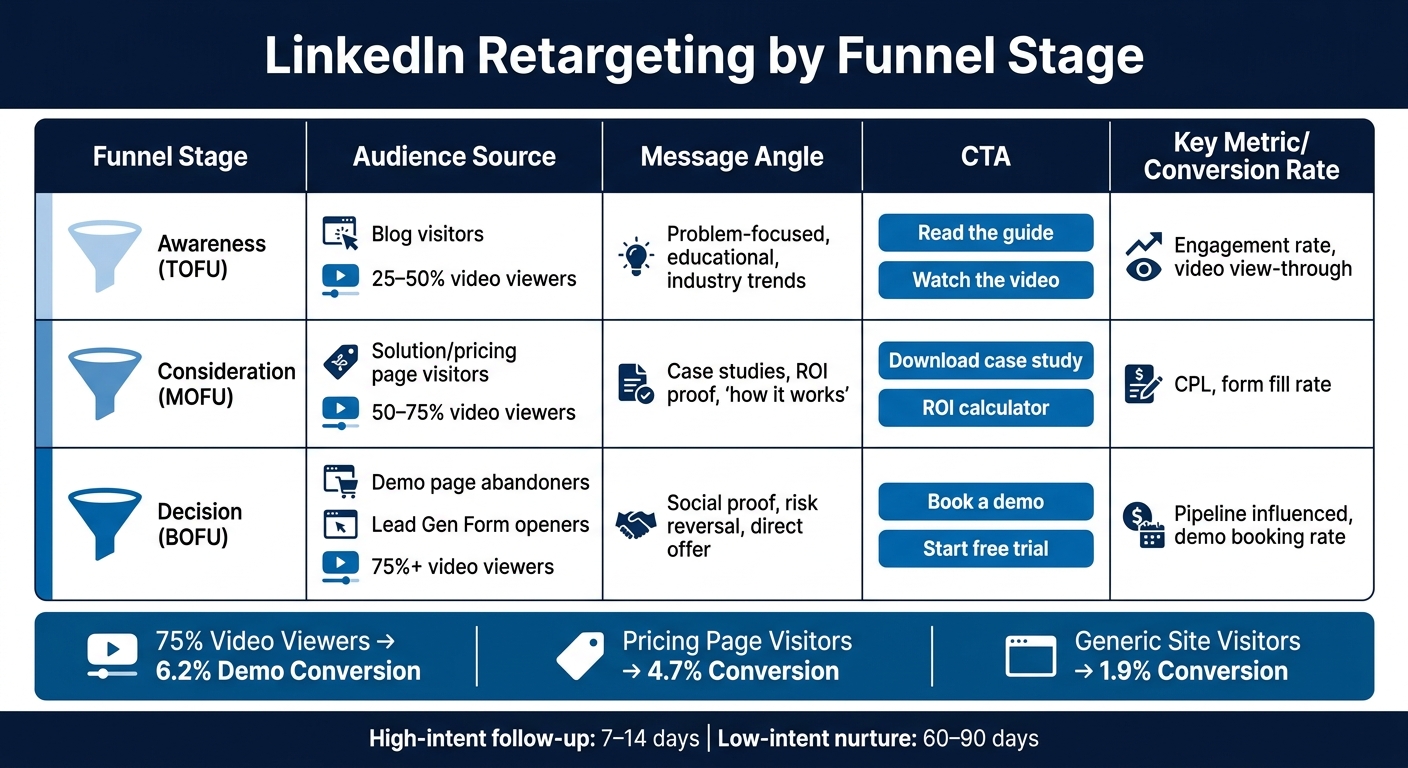
LinkedIn Retargeting by Funnel Stage: Audiences, Messages & Conversion Rates
Stage-based retargeting works because it lines up the message with what the buyer just did. In plain English: don’t show the same ad to everyone. Use the signals from the previous section to sort each prospect into the right retargeting lane.
Top of funnel: reinforce the problem and stay visible
At the top of the funnel, this is not the moment to ask for a meeting. People here - blog readers, social engagers, and those who watched 25–50% of a video - are still getting clear on the problem. The goal is to stay familiar, not force action.
Single Image Ads and Thought Leader Ads tend to work well here. Thought Leader Ads can outperform brand page posts by up to 3x in engagement. Keep the message educational and easy to absorb: industry trends, common mistakes, or a clean way to frame the problem your buyers face. A light CTA like "Read the guide" or "Watch the video" feels natural at this stage. Focus on engagement and view-through, not leads.
Middle and bottom of funnel: deepen evaluation and trigger action
Once someone visits a solution or pricing page, or watches 50–75% of a video, the conversation changes. At that point, they’re weighing whether your product is a fit. This is where case studies, ROI proof, and product walkthroughs come into play. Lead Gen Forms and Document Ads also make sense here. Watch CPL and form fills.
Bottom-funnel audiences - demo page abandoners, Lead Gen Form openers, and 75%+ video viewers - need a more direct push. These prospects have shown strong intent already. Now the job is to remove friction with social proof, a direct offer, or a simple risk reversal.
So the structure is straightforward: educate early, prove value in the middle, and ask for action at the bottom.
| Funnel Stage | Audience Source | Message Angle | CTA | Primary Success Metric |
|---|---|---|---|---|
| Awareness (TOFU) | Blog visitors, 25–50% video viewers | Problem-focused, educational, industry trends | Read guide, watch video | Engagement rate, video view-through |
| Consideration (MOFU) | Solution/pricing page visitors, 50–75% video viewers | Case studies, ROI proof, "how it works" | Download case study, ROI calculator | Cost per lead (CPL), form fill rate |
| Decision (BOFU) | Demo page abandoners, Lead Gen Form openers, 75%+ video viewers | Social proof, risk reversal, direct offer | Book a demo, start free trial | Pipeline influenced, demo booking rate |
One operational note is easy to miss, but it matters: always exclude users who already completed the target action. Retargeting someone who just booked a demo burns budget and makes the experience feel sloppy.
Next, measure whether each stage is moving prospects forward.
Measuring Progression and Supporting It with Postelix
What to track when the goal is pipeline, not just clicks
Once your audience and offer are in place, the next step is simple: figure out whether retargeting is moving buyers forward.
Impressions and clicks can tell you the ad was served and someone interacted with it. But that alone doesn't tell you much. What matters is whether the buyer moved to the next step.
The metric that matters most is stage-to-stage movement - did a blog reader visit the pricing page, and did a pricing page visitor book a demo?
That means tracking things like:
- Qualified visits to pricing, ROI, and demo pages
- Meeting bookings
- Account-level lift
- Influenced pipeline value
Put bluntly, pipeline metrics matter more than ad metrics.
Benchmarks can help as a reference point, but they shouldn't be the main scorecard. The better test is whether people are moving through the funnel and whether that movement ties back to pipeline value.
It's also worth tracking view-through and assisted conversions, not just last-click results.
Where Postelix fits in a human-approved LinkedIn pipeline
When intent is clear, that's the moment to pass it into a human follow-up system.
If a prospect keeps coming back to a demo page or opens a Lead Gen Form, it's time to move beyond retargeting and start a direct LinkedIn conversation. Postelix drafts those DMs in your voice and keeps every message human-approved.
Retargeting helps sort for intent. Postelix turns that signal into a conversation, so the path from interest to pipeline stays personal and on-brand.
FAQs
How many LinkedIn retargeting audiences should I create?
Create 3–5 retargeting audiences to start with. Focus on high-intent groups such as:
- Website visitors
- Video viewers
- Engagement audiences
Try to get each audience to at least 300 members so your ads can deliver well.
What should I do if my LinkedIn retargeting audience is too small?
Grow your audience by loosening your targeting settings.
For example, you can:
- Extend the lookback window from 30 to 90 days
- Include more URL paths
- Combine sources like website visitors, ad engagers, and video viewers
Also, make sure the LinkedIn Insight Tag is installed on all relevant pages. If your traffic is low, focus on getting more website visits first so your audience can reach the 300–1,000 members needed for effective delivery.
When should retargeting hand off to direct LinkedIn outreach?
Retargeting should move to direct LinkedIn outreach once people show high intent - for example, by visiting pricing or demo pages - or after they’ve engaged within 7–14 days.
That timing matters. It helps you reach prospects when they’re most likely to take the next step and convert.