
Engaging thoughtfully in comments can lead to higher response rates and better connections compared to cold outreach. Here's how you can turn public interactions into private conversations that generate leads:
- Monitor High-Intent Comments: Identify comments showing challenges or pain points (e.g., "struggling with X"). Respond quickly - within an hour for high intent.
- Add Value in Replies: Avoid generic praise. Instead, share unique insights or perspectives to encourage profile visits and replies.
- Ask a Focused Question: End your comment with one specific, relevant question to spark further engagement.
- Transition to Direct Messages: Move the conversation to DMs when engagement signals like replies or profile visits are clear.
- Comment Where Your Buyers Are: Engage on posts your target audience already follows to increase visibility.
- Revisit Active Threads: Follow up on threads with new activity to strengthen connections.
- Use Tools for Efficiency: Tools like Postelix can help find high-intent opportunities and streamline your efforts.
These strategies focus on building relationships through meaningful interactions, reducing reliance on cold outreach while achieving response rates of 20–35%. Start small by dedicating 30 minutes daily to commenting, and watch your leads grow.
1. Monitor buying-intent comments
Pay attention to comments where users express challenges with key issues - they’re often easier to identify than you might think.
As Baz Furby, Founder of Grow with Ghost, explains:
"The intent hierarchy works like this: viewers are cold, likers are lukewarm, sharers are warm, but commenters are hot."
High-intent comments tend to stand out with specific patterns. Look for phrases that reflect pain points, such as "we've been struggling with", "I can't justify the cost anymore", or "does anyone know a better way to handle this?" Questions about tools, frameworks, or resources are also strong indicators. Similarly, public complaints about a competitor’s pricing or feature changes can reveal potential buyers. These aren’t casual remarks - they signal a clear interest in finding solutions.
Here’s a real-world example to illustrate the value of this approach. Back in April 2026, the SyncGTM team spotted 34 LinkedIn posts about a pricing change at the software company Clay. Those posts generated over 1,200 comments. By zeroing in on high-intent phrases like "can't justify the cost" and "looking for alternatives", they built a list of 340 qualified contacts. The result? They booked 40 demos in just two weeks, achieving an 11.8% conversion rate.
Before diving into a conversation, take 60 seconds to review the commenter’s profile. Look at their job title, company size, and recent activity. Even the most promising comment won’t lead anywhere if the person behind it doesn’t fit your ideal customer profile. A quick check can save time and effort.
| Intent Level | What the Comment Looks Like | How Fast to Respond |
|---|---|---|
| High | Pain points, solution-focused questions, competitor frustrations | Within 1 hour |
| Medium | Sharing experiences, agreeing with the post, adding context | Within 4 hours |
| Low | Emojis, "Great post!", tagging friends | Within 24 hours or skip |
Speed matters - responding quickly keeps the window of buyer interest open.
Once you’ve identified high-intent comments, make sure your reply adds real value instead of just offering generic praise.
sbb-itb-f8f3793
2. Reply with value, not praise
Generic comments like "Great post!" or "So true!" rarely stand out. They’re easy to scroll past and don’t generate clicks or meaningful interactions. To turn engagement into leads, it’s essential to move beyond surface-level praise and focus on offering real value.
What makes a comment effective? Adding something new - whether it’s a unique data point, a different perspective, or a thoughtful counterpoint. Marcus Webb from Tools & Automation, LinkedInsider, explains it perfectly:
"A comment earns a click when it adds something the post did not already say."
Specific and useful replies are much more likely to prompt profile visits and spark conversations. For instance, comments with over 15 words get 3.4 times more engagement than short reactions. Additionally, a respectful disagreement or a polite counterpoint generates 2.1 times more replies than simply agreeing.
The goal here isn’t to sell - it’s to make someone think, "Who is this?" To do that, reference a specific point from the post, share unique insights, or invite further discussion. Keep your comment concise, ideally between 30–80 words. Anything longer can come across as overwhelming or overly dominant in the conversation.
This approach works. In May 2026, Ken Marshall, Co-Founder of Meet Sona, revealed that strategic commenting - mixing rapport-building, contrarian insights, and problem-solving - was responsible for over 60% of the company’s user and customer growth. By dedicating just 30 minutes daily to thoughtful engagement, they secured discovery calls and even high-ticket consulting deals.
3. Ask one focused follow-up question
After contributing a meaningful comment, the next step is to wrap it up with one clear, targeted follow-up question. Why just one? Because too many questions can overwhelm the person you're engaging with, making them less likely to respond. A single, well-thought-out question keeps things simple and encourages a reply. This method builds naturally on the value-driven commenting approach mentioned earlier.
As Zain Ul Abdin explains:
"Every comment you leave should end with a question. Not a generic one. A qualifying one."
The key is making your question specific and relevant to the context. It should connect directly to what the person said or the post they shared, rather than feeling like a generic template. For example, instead of asking something broad like, "What do you think?", try a more pointed question such as: "Are you finding it harder to bring the right people to the table, or to get them aligned once they’re there?" This type of "A or B" question is easy to answer and also helps uncover the other person’s challenges or priorities.
Focused questions like these can spark meaningful conversations that help nurture leads. For example, research shows that a three-step process - starting with a valuable comment, followed by a soft qualifying question - converts 34% of engaged commenters into sales discussions, compared to just 8% for cold outreach. Why the difference? Because asking a thoughtful question shows genuine curiosity, not a hidden sales pitch, and that authenticity resonates with buyers.
To keep your comment effective, stick to a simple three-sentence structure: one insight, one proof point, and one question. Aim for no more than four sentences total. As Ken Marshall, Co-Founder of Meet Sona, wisely points out: "If your comment is longer than the post you're commenting on, you're not commenting anymore, you're hijacking."
4. Move the conversation to direct messages
After leaving a meaningful comment and asking a thoughtful follow-up question, the next step is to transition the conversation to direct messages (DMs) when the engagement signals are clear. A direct reply to your follow-up question is often the green light to move things to private messaging. This shift allows for more focused discussions about a specific issue or need.
Pay attention to key signals like replies and profile visits. If someone responds to your comment and then checks out your profile, it’s a strong sign of interest. In this case, reaching out via DM won’t feel out of place. However, if someone only likes a post without engaging further, continue interacting publicly instead of rushing to DMs. Moving too quickly is a common misstep.
"Moving to the DM is justified after repeated engagement, a direct reply to your comment, reciprocal profile view activity, or deep topic-level relevance tied to a known pain point." - ScaliQ
When you do send a DM, keep it short - under 100 words is ideal. Reference the specific post or conversation that led to the message. This makes your outreach feel personal and relevant, rather than like a generic cold message. You can also include something helpful, like a relevant article, report, or actionable tip, but avoid pitching or pushing for a demo at this stage.
The numbers back this up: comment-driven DMs see response rates of 20–35%, compared to just 5–15% for cold outreach. That’s because your public interaction has already established familiarity, making your private message feel like a natural progression. The groundwork you’ve laid publicly does most of the work - your DM simply continues the conversation.
5. Comment on posts your buyers are already reading
Engaging beyond your own content is a great way to connect with potential leads. Instead of waiting for your ideal buyers to stumble upon your content, you can take the proactive route by interacting with posts they already follow. This tactic lets you meet your audience where they are, regardless of the subject matter.
Your buyers are likely following consultants, analysts, and industry voices who discuss challenges that align with the solutions your product provides. By leaving thoughtful comments on these posts, you can tap into their audience. As Marcus Webb from Tools & Automation explains:
"A sharp comment borrows the original poster's audience for free." - Marcus Webb, Tools & Automation, LinkedInsider
The trick is to be intentional. Rather than spreading yourself thin by commenting on random posts, focus on a curated list of 20–30 accounts whose followers match your target audience. This list might include industry leaders, complementary brands, or comparing Postelix vs Taplio to find tools that support this intent-led growth. Consistently showing up in the same conversations builds familiarity - both with the original poster and the audience reading the comments. Random, scattered comments won’t leave the same impression. By focusing your efforts, you extend your strategy of providing value-driven, intentional engagement. This approach not only enhances your visibility but also creates opportunities for future direct conversations.
When deciding where to comment, aim for posts that indirectly relate to your product. For example, if you sell workflow tools, look for discussions about team burnout or operational challenges - topics that naturally attract your ideal buyers. Comments on such posts can lead to increased profile views, keeping you on the radar of those who are already interested. Timing is critical too - commenting within the first 60–90 minutes of a post going live ensures your input gets noticed before the conversation becomes too crowded. The goal? To make sure your name stands out to the right people, at the right time, so when you reach out later, you’re already a familiar face.
6. Re-engage when a Thread Picks Up Activity
Revisiting threads where you've already engaged can turn casual interest into meaningful leads. Too often, people leave a comment and forget about it, missing a chance to deepen the conversation. When a thread you’ve participated in starts gaining new replies or reactions, it’s a clear sign that the audience is still engaged.
Think of your initial comment as planting a seed. Following up when the thread becomes active again shows that you’re paying attention and genuinely interested. If someone responds to your comment days later, it’s often a sign of genuine interest - don’t let that go unnoticed.
Ken Marshall, Co-Founder of Meet Sona, sums it up perfectly:
"The whole point of commenting is to start a conversation, and the conversation only happens if you keep showing up."
Make it a priority to reply to responses within 24 hours. If someone asks a question, give a thoughtful and direct answer. If it’s just a compliment or acknowledgment, a simple “thank you” can keep the dialogue going. This consistent engagement helps strengthen the connection you started with your earlier comments.
Another key signal to watch for is profile views. If someone checks out your profile after interacting with you, it’s a sign of strong interest. Use this as a chance for a personalized outreach, keeping their context in mind.
7. Use Tools to Find High-Intent Comment Opportunities
Automated tools can make finding high-intent comment opportunities much faster and more efficient. Manually scrolling through threads to spot the right conversations is not only time-consuming but often ineffective - by the time you find a relevant post, the discussion might already be over. Tools can take the guesswork out of the process by actively monitoring for opportunities where your target audience is already engaged.
Postelix is a great example. It identifies posts where your ideal buyers are active by tracking intent keywords and competitor activity. This means you get notified about relevant conversations almost immediately - sometimes in as little as 60 seconds.
One standout feature of Postelix is its daily "comment missions". These are curated lists of high-intent posts tailored to your goals, allowing you to jump into meaningful conversations in just 15 minutes a day. This approach keeps your efforts focused and efficient.
But finding the right posts is only half the battle. Engaging effectively is just as important. Postelix’s Voice Profile feature helps by automatically drafting personalized and natural-sounding comments. This way, you can respond quickly while still maintaining a genuine tone.
"The connection acceptance rate from comment-scraped LinkedIn lists ran at 61% - nearly double the 25–35% typical of Sales Navigator-sourced lists. The difference is context: people remember their own public comments." - SyncGTM Team
This highlights a key trend in B2B prospecting: context matters more than cold outreach. When you consistently show up in relevant comment threads, you're not just another name in someone’s inbox - you’re already part of the conversation. Tools like Postelix make it easier to integrate this strategy into your routine, ensuring you stay connected with high-intent prospects.
Comparison Table
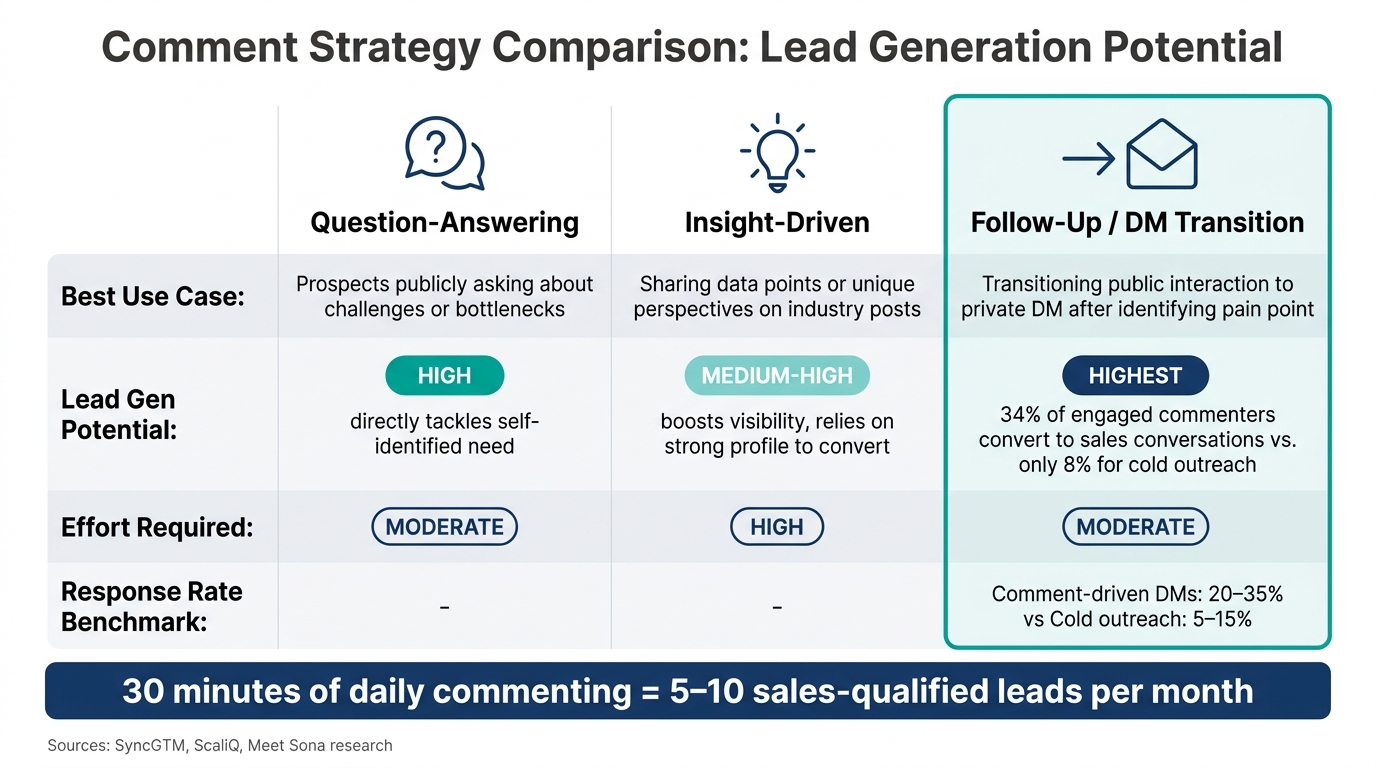
Comment-Driven Outreach vs Cold Outreach: Lead Gen Stats
Different comment strategies can lead to varying outcomes in generating leads. Here's a breakdown of three main approaches, showing how each fits into a broader lead generation strategy.
| Comment Type | Best Use Case | Lead Gen Potential | Effort Required |
|---|---|---|---|
| Question-Answering | Engaging with prospects who publicly ask about specific challenges, like bottlenecks or "how-to" problems | High - directly tackles a clear, self-identified need, signaling the prospect is actively seeking solutions | Moderate - requires expertise but follows a straightforward problem-solution approach |
| Insight-Driven | Sharing a data point, unique perspective, or example on an industry-related post to establish authority | Medium-High - boosts brand visibility and attracts profile clicks, relying on a strong profile to convert | High - demands a distinctive viewpoint or well-structured input to stand out |
| Follow-up | Transitioning a public interaction into a private DM after identifying a prospect's pain point | Highest - converts engaged commenters effectively; a 3-touch sequence converts 34% of engaged commenters into sales conversations, compared to only 8% for cold outreach | Moderate - requires personalization and timing to avoid coming across as spammy |
Each of these strategies contributes to building trust through thoughtful engagement. Among them, follow-up comments and DMs consistently yield the best conversion rates. However, if you're just starting, question-answering comments are a great place to begin. They focus on prospects who have already highlighted their specific challenges, so there's no need to guess their intent - it's clearly stated in the conversation.
Conclusion
The strategies discussed here highlight a simple truth: context always outperforms cold outreach. Whether you're responding to a prospect's public question, sharing a thoughtful insight on their post, or sending a direct message at just the right moment, these methods work because they prioritize relevance over random guesses.
And the data backs this up. A consistent daily habit of just 30 minutes spent on targeted commenting can result in 5 to 10 sales-qualified leads each month. Even better, outreach driven by comments achieves response rates of 20–35%, far surpassing the 5–15% average for cold DMs. Ken Marshall, Co-Founder of Meet Sona, sums it up perfectly:
"There is no higher ROI activity than engaging in the comments with people you want to do business with, pulling them into a real conversation, and translating that into a discovery call."
The key is consistency. Regularly showing up in the right comment sections builds familiarity, making future conversations much easier. Over time, your presence becomes recognizable, and that familiarity lowers the resistance to engagement before you even send a direct message. This compounding effect underscores the power of context-driven outreach covered throughout this article.
Ready to put these strategies into action? Tools like Postelix can help you identify active buyers and craft personalized, engaging comments quickly. Start small - pick one or two strategies, stick with them, and watch your pipeline grow. It all begins with showing up.
FAQs
How do I spot high-intent comments fast?
To spot high-intent comments quickly, pay attention to language that highlights pain points, frustrations, or direct solution-seeking questions. Skip over generic feedback like "great post" as it doesn't offer much insight. Instead, focus on categorizing commenters: high-intent users often express clear needs or challenges, while low-intent users might simply tag others or drop unrelated links. Using tools like Postelix can streamline this process by analyzing user activity and helping you zero in on prospects with relevant job titles and companies, making follow-ups more effective.
When is it okay to move a comment thread into DMs?
When it makes sense to shift a conversation from a public comment thread to direct messages, timing is everything. This move works best when you've already built a rapport through public interactions or spotted strong buying signals. For instance, if someone asks about your product, shows interest in a resource you’ve shared, or seems ready for a more in-depth discussion, it’s a good time to take it private.
Using tools like Postelix can help you pinpoint warm leads effectively. Just make sure to establish a connection first - jumping straight into DMs without context can feel spammy and might put people off. Focus on making the transition feel natural and welcomed.
What should I say in a value-adding comment without sounding salesy?
To genuinely contribute without coming across as overly promotional, share a personal insight or a story that ties into the topic at hand. Keep it concise - just a few sentences that feel authentic and encourage further dialogue. For instance, ask a question that sparks thought or offer a tip that others can apply. Tools like Postelix can help pinpoint potential leads and create tailored, engaging comments that foster trust and encourage meaningful interactions, all without sounding like a sales pitch.