
Comments do not turn into pipeline on their own. I turn them into buyer conversations with a simple 3-step flow: spot intent, reply in public, then send a short DM with context.
If I skip the follow-up, even a post with hundreds of comments can lead to zero meetings. If I reply fast and keep the message tied to the exact comment, social engagement can turn into 2–4 meetings per week. The key is not more visibility. It is a system.
Here’s the whole idea in plain English:
- Most comments are not leads
- I look for pain, timing, or direct interest
- I check the profile in about 60 seconds
- I reply in public first so the outreach does not feel abrupt
- I send a short DM in under 100 words
- I ask for one small next step, like a 15-minute chat
- I track DM reply rate, poster reply rate, and meetings booked
A few benchmarks from the article stand out:
- 25%+ original poster reply rate
- 15%+ DM reply rate
- 2–4 meetings booked from social each week
- DM timing matters: high-intent comments should get a reply within 1 hour to 24 hours
What I like about this approach is that it keeps outreach tied to a real moment. A comment like “We’ve been struggling with this for months” is far more useful than a generic like or “great post.”
If I had to sum it up in one line, it would be this: use comments as conversation starters, not vanity metrics.
How to Spot Buyer Intent in Comments
Comments that signal real interest, pain, or timing
Once a comment shows intent, the next step is figuring out what matters and what doesn't.
Not every comment is worth a follow-up. Focus on comments that show pain, timing, or buying intent - signs that someone may be open to a conversation.
The strongest signals usually come from:
- Tactical questions
- Workflow complaints
- Timing cues, like pricing changes or comments about switching tools
- Comments on competitor or category content, which tend to mean more than a simple like
A fast qualification check before sending a DM
Take 60 seconds and scan the profile. Look at the person's role, company fit, and recent activity.
Put decision-makers first. Compare the person against your ICP. Skip inactive profiles and obvious competitors.
The comment itself also helps you qualify. Phrases like "looking for alternatives," "can't justify the cost," or "switching away" are strong signs and deserve attention. That's what turns public engagement into a real conversation opening.
That filter helps you decide who should get a response now.
Using Postelix to find high-value comment opportunities
Postelix helps surface buyers who are showing intent by tracking relevant category conversations and competitor engagement. It highlights high-value comment opportunities, scores them against your ICP, and gives you the context you need to reply fast in your own voice.
From there, you can move the best comments into a simple public-to-private workflow.
sbb-itb-f8f3793
How to Write LinkedIn DMs That Get Replies (And Close More Sales)
A Simple Workflow From Public Comment to Private Conversation
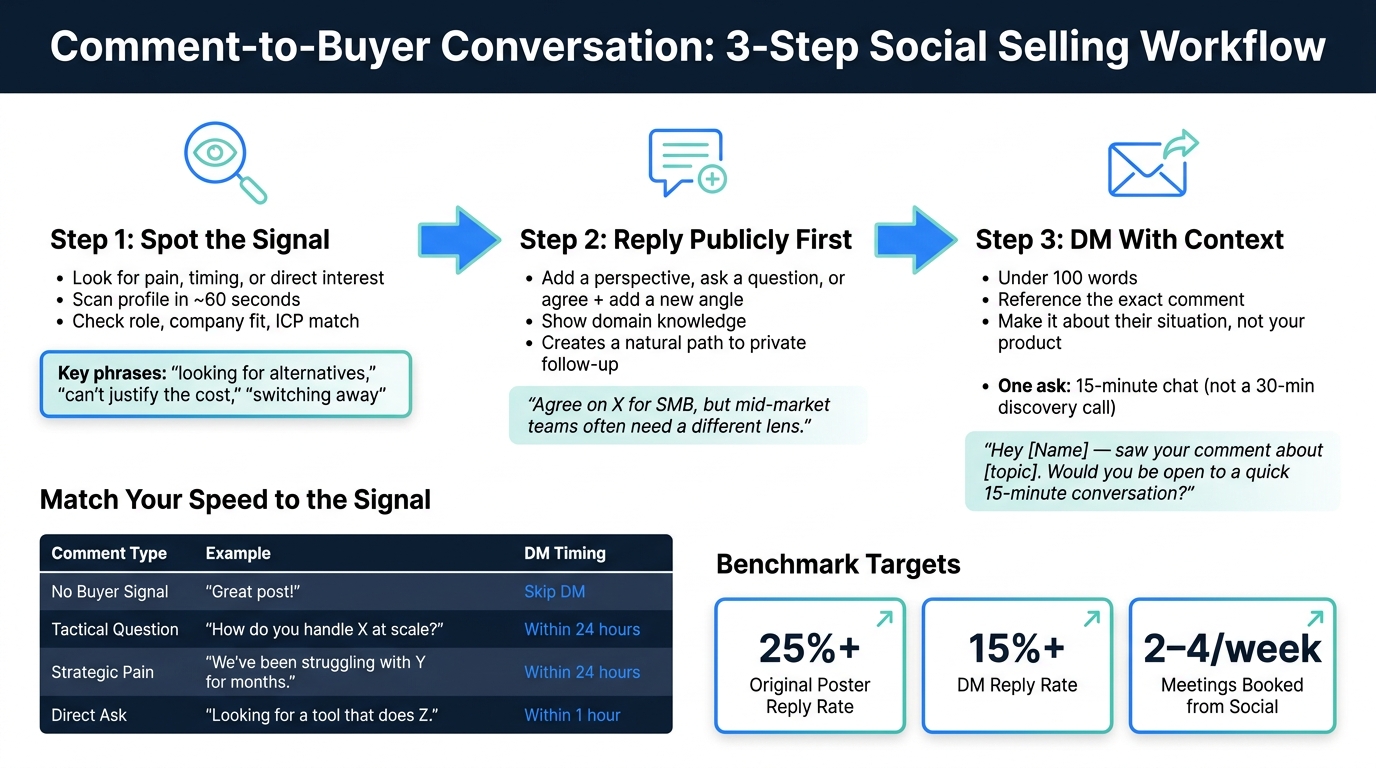
Comment-to-Buyer Conversation: 3-Step Social Selling Workflow
Once a comment clears the intent check, start in public first.
Start in public with a useful reply
Jumping right to “DM me” can feel abrupt. A better move is to reply in the public thread with something specific and useful.
You have three solid options: add a perspective, ask a thoughtful question, or agree and add a new angle. If someone says they’re struggling to justify the cost of their current tool, don’t stop at validation. Add a constraint or counterpoint that shows you get the tradeoff. For example: "Agree on X for SMB, but mid-market teams often need a different lens." That kind of reply shows you know the space and helps the rest of the thread too.
A good public reply does two jobs at once: it shows domain knowledge and creates a natural path to a private follow-up.
Move to DM with context and one low-friction ask
After a few useful public exchanges, move to DM with context.
Keep the first message short, under 100 words. Mention the exact comment so it’s clear you’re not sending a template. Make it about their situation, not your product. Then end with one easy ask. Offer a 15-minute conversation, not a 30-minute discovery call.
Here’s what that looks like:
"Hey [Name] - saw your comment about [topic]. I had a thought on how teams are handling it and would love to compare notes. Would you be open to a quick 15-minute conversation?"
No product name. No calendar link. Just one simple question.
Comment-type decision table
Use the signal to decide pace and depth.
| Comment Type | Example | Action | Timing |
|---|---|---|---|
| No buyer signal | "Great post!" | Reply once publicly; skip DM. | - |
| Tactical question | "How do you handle X at scale?" | Reply publicly with a short insight, then DM a relevant resource. | DM within 24 hours |
| Strategic pain | "We've been struggling with Y for months." | Reply publicly by validating the pain, then DM with context. | DM within 24 hours |
| Direct ask | "Looking for a tool that does Z." | Public reply with value; immediate DM with a resource or offer to help. | DM within 1 hour |
Match your speed to the signal. Higher intent means a faster DM.
How to Keep Comment-Led Outreach Human and Scalable
Why voice consistency matters across posts, comments, and DMs
Once a comment shows intent, the next step is simple: your follow-up still has to sound like you.
The public comment is where trust starts. The DM is where that trust either holds up or falls apart. And the issue usually isn't automation by itself. It's the shift in voice. If your public comments are sharp and specific, but your DM starts with a bland template, the connection breaks right there.
That's why voice consistency across posts, comments, and DMs matters so much. It makes outreach feel like one continuous conversation instead of three different people talking. If you're scaling replies and DMs, that standard can't slip.
Human-in-the-loop outreach with Postelix
Postelix helps you spot high-value comments, draft on-voice replies and DMs, and keep every send human-approved.
The drafts are tuned to your positioning, language, and buyer context. That means the message doesn't drift into stiff, canned outreach. And because every draft is still human-approved, you keep control over what goes out.
You can run it in a web dashboard or inside the tools you already use.
Canned outreach vs. calibrated outreach: a comparison
The gap shows up fast in how buyers respond.
| Canned/Automated | Human-Reviewed | |
|---|---|---|
| Tone | Generic | Specific |
| Relevance | No context | References the comment |
| Trust impact | Triggers sales alarms | Builds trust |
| Pipeline value | Low conversion | Higher conversion |
| Control | No review | Human-reviewed |
Canned outreach leans on volume. Calibrated outreach focuses on the kind of conversation that can actually go somewhere.
Build the System and Track What Converts
Once you have the public-to-private workflow in place, the last piece is cadence.
A 15-minute daily routine for founders and lean teams
When the workflow is clear, run it every day. Fifteen minutes is enough.
- Minutes 0–5: Reply to any overnight DMs and comments on your own posts.
- Minutes 5–10: Leave 3–5 useful comments on posts from ICP prospects, buyers, or category leaders. Use the A3 framework.
- Minutes 10–15: Send 2–3 tailored DMs to people who engaged with your comments or posts.
The goal isn't spending more time. It's being consistent.
Metrics that show comments turning into conversations
Next, track what actually moves into conversation, not just what gets views.
| Funnel Stage | Metric | Target Benchmark |
|---|---|---|
| Visibility | Original poster reply rate | 25%+ |
| Outreach | DM reply rate | 15%+ |
| Pipeline | Meetings booked from social | 2–4/week |
| Efficiency | ICP commenters with intent | Match your ICP and show intent signals |
A reply from the original poster is an early sign that a later conversation may happen.
If you're booking fewer than 2 meetings a week from social, take a hard look at where your comments are going. Are you spending time with actual ICP prospects, or mostly talking with peers?
Conclusion: Make comments a repeatable buyer conversation channel
Most LinkedIn engagement stays passive because there's no system behind it. But buyer intent shows up in comments all the time, especially in the questions people ask and the frustrations they share.
The path from comment to conversation is simple: spot the signal, reply in public with something useful, then move to a DM that refers to the actual context. Keep your voice steady across all three steps. Postelix helps surface high-value comment opportunities and draft on-voice replies and DMs without losing control.
Here, consistency beats volume every time. Comments stop being passive engagement and start creating buyer conversations. That turns comments into a repeatable pipeline channel instead of a one-off tactic.
FAQs
How do I tell real intent from casual engagement?
Focus on the substance, not just the action. A like or a generic comment usually signals low intent.
Real intent tends to look different. It shows up when someone:
- asks about a pain point
- describes a workflow bottleneck
- shares frustration with current tools
- comes back and engages more than once with content in your category
From there, check their profile against your ideal customer profile. Only move to private messages after repeated interactions, a thoughtful reply, or clear topic relevance.
Postelix can help surface high-value comment opportunities and signs of genuine buying intent.
What should I say in the first DM?
Open your first message by making the prospect feel noticed, not pitched to.
Point to one specific idea from their recent post or comment. That small detail shows you paid attention and aren't blasting out the same note to everyone.
Then lead with curiosity. Ask one open-ended question that puts them in the expert seat.
Skip the usual sales move:
- no links
- no calendar invite
- no pitch
The goal is simple: get a reply, not push for a meeting.
How long should I wait before following up?
For public engagement, reply to a comment within 24 hours.
If you want to move the conversation to a direct message, do it within a few hours while the exchange is still fresh in the other person's mind.
One thing matters here: don't jump straight into a DM. Start with a bit of public back-and-forth first. Then, after your public reply, wait a few hours before reaching out privately so it feels thoughtful instead of automated.