Postelix

LinkedIn ads audiences built from your named market

Most LinkedIn ad budgets are spent against a title filter. You pick seniority, function, industry and company size, LinkedIn shows you an audience of 180,000 people, and you buy impressions against a group where nobody has shown any interest in your category.

A named market changes the input. You already know which people react to category content, which companies they sit in, and which roles they hold. That turns into a company list plus a title layer for LinkedIn Campaign Manager.

This page covers how matched audiences actually work, what the minimums are, what we hand you today, and what the EU rules mean for contact lists.

How LinkedIn matched audiences work

Campaign Manager lets you upload your own list and target against it. There are two kinds, and the difference matters more than most teams realise.

A company list matches organisations. LinkedIn asks for at least one of: company name, company website, company email domain, LinkedIn Page URL, or stock symbol. Adding industry, city, state, country or the LinkedIn Page URL improves the match rate, and LinkedIn asks for the Page URL to end in the company name rather than a numeric ID (as published on linkedin.com, September 2026).

A contact list matches individual members. LinkedIn asks for at least one of: email address, first and last name, or a mobile device ID (as published on linkedin.com, September 2026).

The published limits are the same for both:

RuleCompany listContact list
Minimum rows to upload300300
Maximum size20 MB or 300,000 companies20 MB or 300,000 records
Minimum matched member accounts to run300300

LinkedIn also publishes what it considers a workable size, which is far above the minimum. The stated minimum for an ad set is 300 member accounts, but LinkedIn suggests a minimum of 50,000 to drive results, suggests at least 300,000 for Sponsored Content and Sponsored Messaging, and 60,000 to 400,000 for text ads (as published on linkedin.com, September 2026).

Thought leader ads are the third piece. LinkedIn lets you sponsor a post published by a member: an employee, a creator, or a member who is a first, second or third degree connection. Public text posts, single image posts, videos, articles and newsletters are eligible. Celebrations, documents, polls, multi-image posts and reposts are not. You need the creator's permission through a request in Campaign Manager, and the supported objectives are brand awareness and engagement, with video views available for video (as published on linkedin.com, September 2026).

Why job title targeting on LinkedIn wastes budget

Title targeting reaches people who typed the right words into a profile field. It cannot tell the difference between a VP of Customer Experience who reads three category posts a week and a VP of Customer Experience who last opened LinkedIn in March.

You pay the same CPM for both. In a market of the size LinkedIn wants you to buy against, the second group is most of the audience.

There is a second problem. Title filters keep pulling in people whose title matches and whose category is wrong. Nine of the ten highest-title people in a filtered audience can sit in industries that will never buy from you, and the filter has no way to know.

A named market does not fix targeting on its own. What it fixes is the input: you know which companies contain proven category attention, so the company list carries evidence rather than a guess.

How a named market becomes a company list plus a title layer

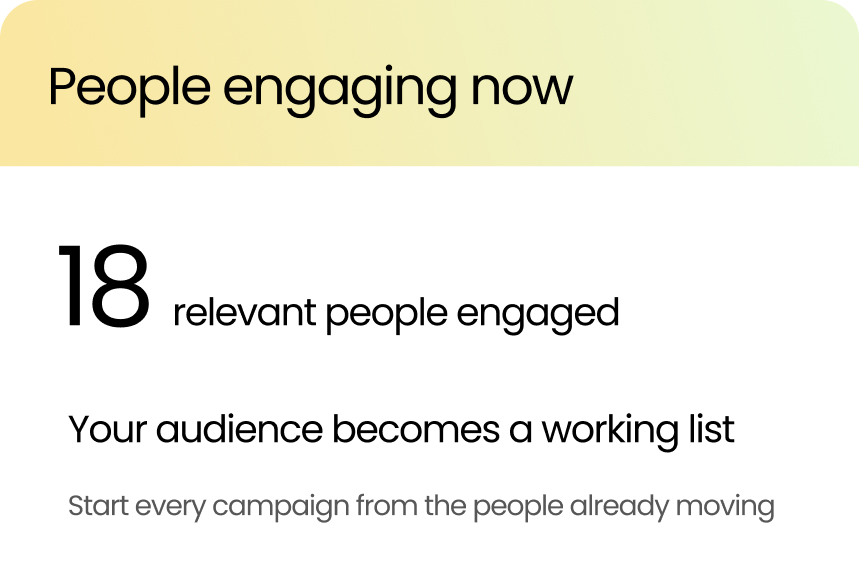
The market is the peopleA few thousand named people, each with a role, a company and a public act behind them.
Roll up to companiesThe companies those people sit in become the company list. A market of 2,500 people usually rolls up to several hundred companies.
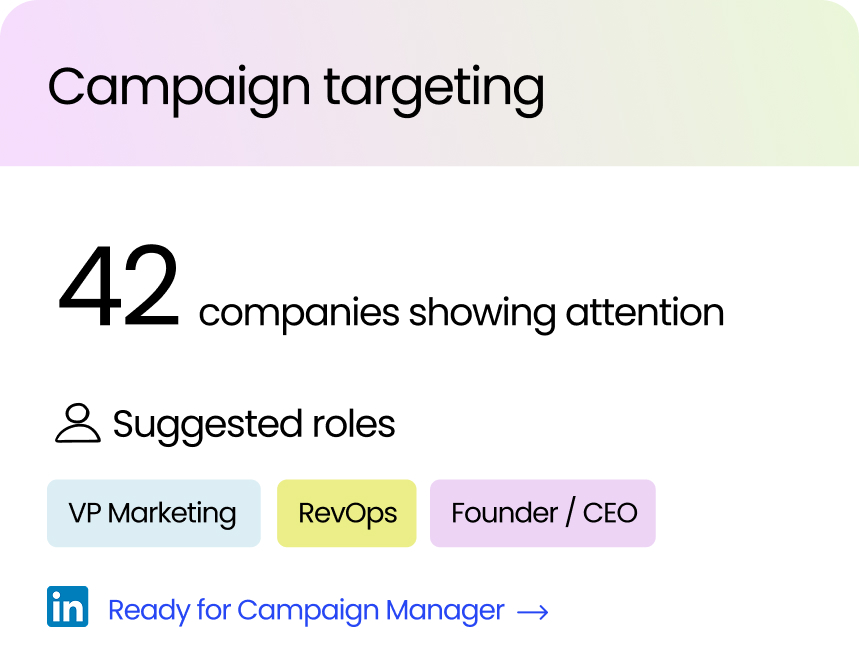
Add the title layerInside Campaign Manager you layer the roles that decide and influence in your category over the company list, which is how the audience expands to a size LinkedIn will run.
Check the floorIf your market rolls up to fewer than 300 companies, the list will not upload on its own. You either widen the market, or combine several lists, which LinkedIn allows in order to reach the minimum.
Re-cut weeklyThe market moves every week, so the company list is not a one-time upload.

The expansion step is the point. A 2,500 person market is far below the 50,000 LinkedIn suggests as a working audience. The same market expressed as 600 companies plus a title layer reaches a size that will actually deliver, while every company in it earned its place through category attention.

What Postelix hands you for LinkedIn ads today

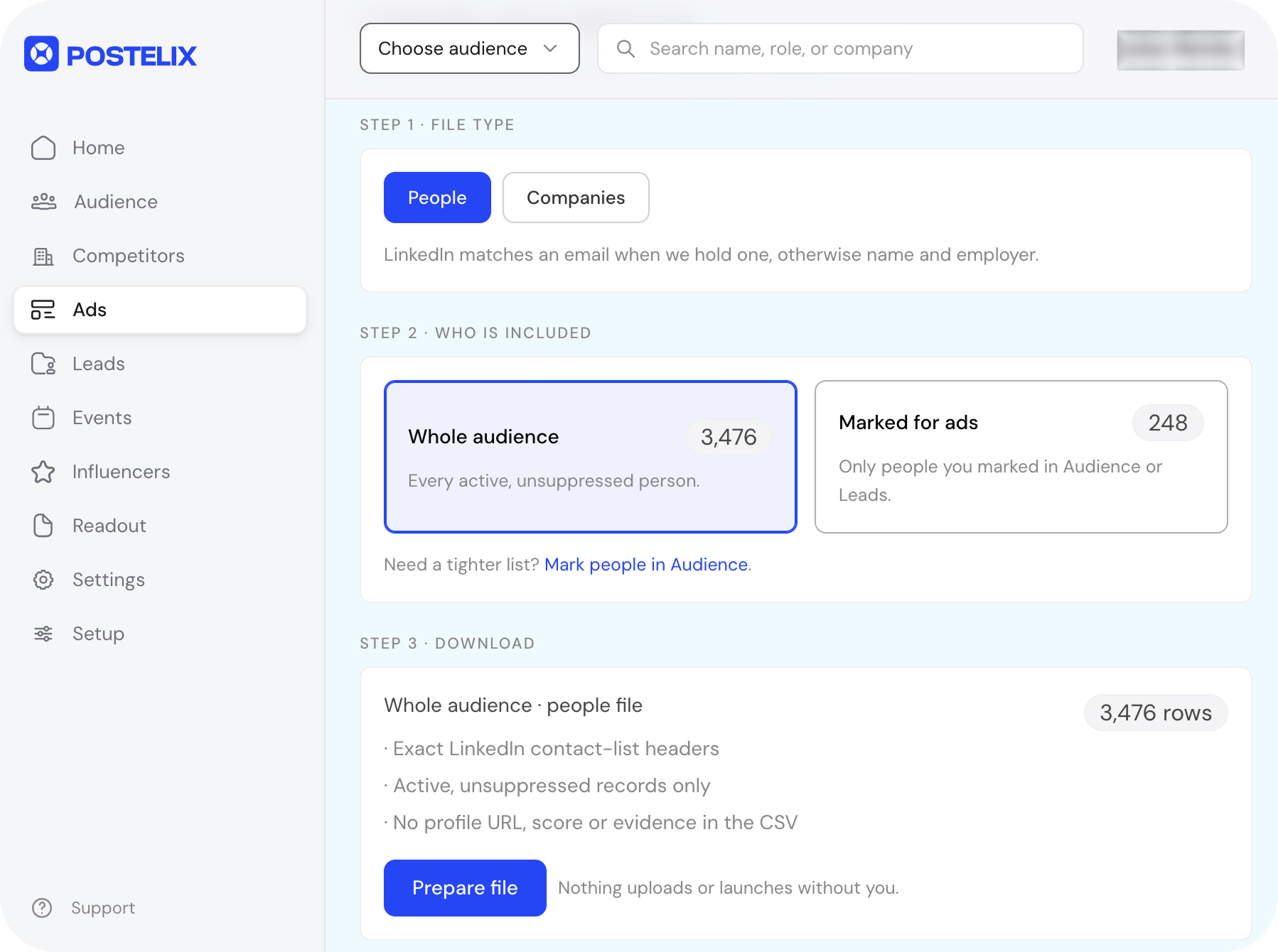
We hand you the company list and the title layer. That is the whole of it.

The company list is the rolled-up companies from your market, formatted for a Campaign Manager upload. The title layer is the set of roles we filter your market to, written so you can apply it in Campaign Manager yourself.

An export tab inside the product, one click from your market to a Campaign Manager CSV, is specified and not built. Today you get the list and you upload it. We would rather write that plainly than imply an integration that does not exist.

There is no automatic promotion of a winning post and no access to your ad account. What you spend, on what creative, stays in your hands.

How ad engagement comes back as named people

When a sponsored post is a real post on a real profile or page, the reactions and comments on it are public. Those come back into your market as named people with the post attached, the same way engagement on an organic post does.

That is the strongest argument for thought leader ads over a purely paid creative. You sponsor something that lives on a person's profile, the market reacts to it in public, and the reactions are people you can name and follow up with.

Two honest limits. Engagement on a sponsored post is not a purchase and not a request to be contacted, so treat it as attention and nothing more. And a piece of creative that exists only as an ad, with no public post behind it, does not produce a public reaction list, so the return path is weaker there.

LinkedIn matched audiences and the EU rules

This is the part most guides skip.

LinkedIn states that customers are responsible for legal compliance for any personal data they provide, and should make sure they have a legal basis and the right to provide it. LinkedIn also states that matched audiences require GDPR consent from members in the EEA, Switzerland and the UK for member level matching (as published on linkedin.com, September 2026).

In practice that makes a contact list the harder route for a European market. You need a legal basis for the personal data you upload, and the member level match in the EEA depends on the member's own consent state.

A company list is the safe default. It contains organisations, not people, and the targeting happens inside LinkedIn against members who chose to say where they work. It is also the format that expands to a workable audience size, which is why we build it that way.

Postelix is a brand of Unfair Advantage Ltd in Cyprus and the product is built for the European rules. We are not going to hand you a badge that says compliant. Take your own advice on your own legal basis, and start with the company list.

Questions

LinkedIn states the minimum for an ad set is 300 member accounts, and an uploaded list must match at least 300 member accounts to run. LinkedIn separately suggests a minimum of 50,000 to drive results, and at least 300,000 for Sponsored Content (as published on linkedin.com, September 2026). That gap between the hard floor and the suggested size is why a named market is used as a company list with a title layer over it, rather than as a list of people.

Check whether you are targeting people or companies. A named market of a few thousand people rolls up to several hundred companies, and a company list plus a title layer expands into an audience LinkedIn will deliver against. LinkedIn also allows you to select several lists together to reach the minimum.

Not as a person level audience in the EEA without a legal basis and member consent, which is why we do not recommend that route. What you can do is target the companies those people sit in, with your title layer over the top. The evidence of category attention carries across to the company, and the format stays on the safe side.

LinkedIn lets you sponsor a post published by a member rather than by your company page: an employee, a creator, or a first, second or third degree connection. Public text, single image, video, article and newsletter posts are eligible, while celebrations, documents, polls, multi-image posts and reposts are not, and you need the creator's permission (as published on linkedin.com, September 2026). We use them to put a post that already earned reactions in front of the market at scale.

No. We hand you the company list and the title layer and you upload them yourself. An in-product export tab straight to Campaign Manager is specified and not built yet.

We recommend around EUR 500 per month alongside Tier 1, which is enough to keep a company list warm rather than to run a demand programme. The budget is there to keep a named market warm at a size you can check.

Get the company list before you spend anything

We build a readout of your market, roll it up to companies and show you the title layer on a call.