If you're using LinkedIn for B2B lead generation, you might wonder whether to use manual outreach or automation tools. Here's the gist:
- Manual Outreach: Time-intensive but highly personal. Best for building trust in high-value deals (e.g., $50k+ contracts). Response rates can hit 25–40%, but scalability is limited to around 50 messages per week. Labor costs are higher, averaging $15–$40 per reply.
- Automation: Efficient and scalable. Ideal for testing markets or engaging large audiences (10,000+ prospects). It can handle 100+ actions daily, cutting costs to $5–$12 per reply. However, risks include account restrictions and potential damage to your brand if done poorly.
The Best Approach? A hybrid strategy. Use automation for repetitive tasks like prospecting and follow-ups. Switch to manual outreach for warm leads or high-value prospects. This blend maximizes efficiency without sacrificing relationship quality.
Quick Comparison
| Factor | Manual Outreach | LinkedIn Automation |
|---|---|---|
| Time per Week | 12–15 hours (50 prospects) | 3–5 hours setup; 1 hour/week upkeep |
| Daily Actions | 20–50 | 10–100+ |
| Response Rate | 25–40% | 8–25% |
| Cost per Reply | $15–$40 | $5–$12 |
| Best Use Case | High-ticket deals (>$50k) | Market testing, lead qualification |
A 70/30 split - 70% automation, 30% manual - can boost conversions by 25–35%. Let automation handle scale, and use manual efforts to close deals and nurture key relationships.
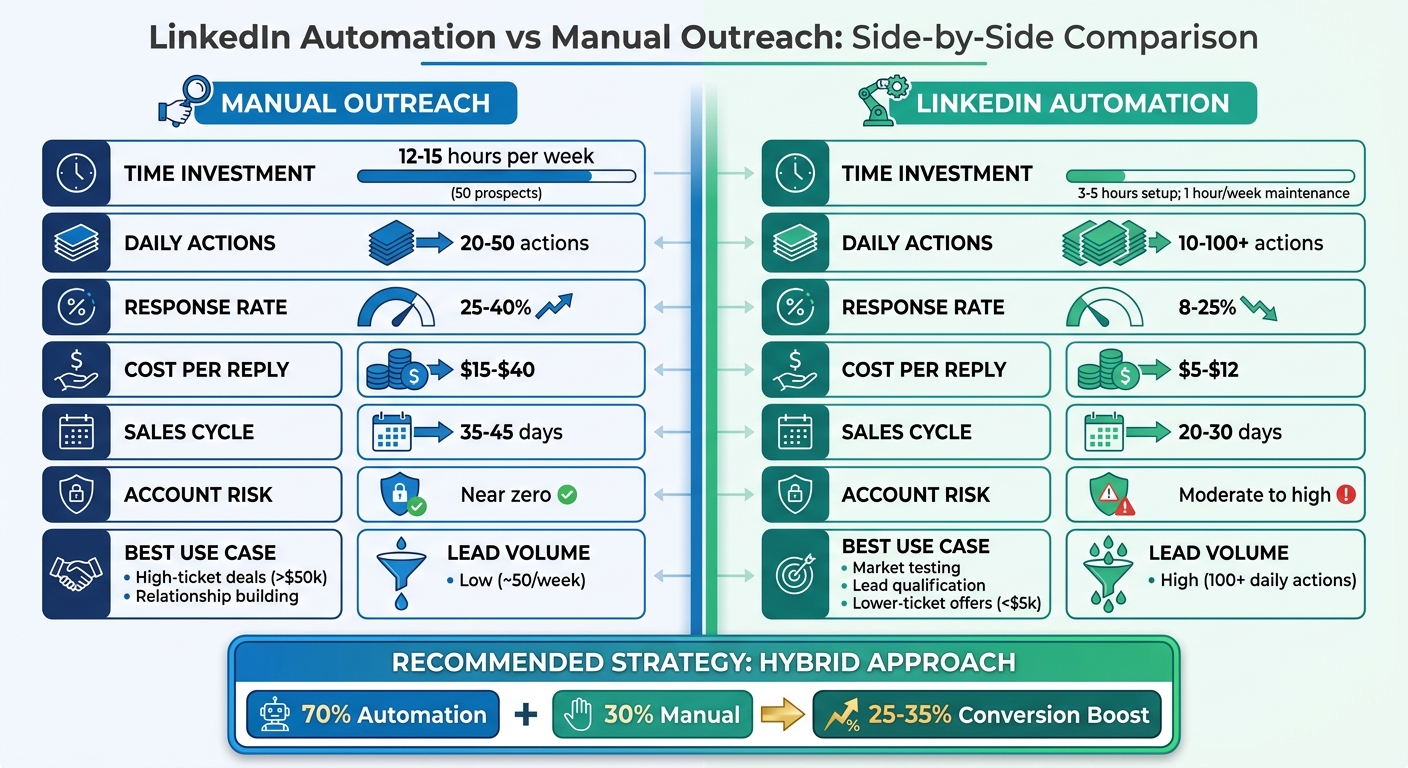
LinkedIn Manual Outreach vs Automation: Key Metrics Comparison
Manual first.Automation second. That’s how you hit 25%+ response rates on LinkedIn. #sellbetter #ai
sbb-itb-f8f3793
Manual Outreach: Pros and Cons
Manual outreach involves researching prospects, crafting personalized messages, and sending connection requests one at a time. Let’s break down what makes this approach appealing and where it might fall short.
Advantages of Manual Outreach
One of the standout benefits of manual outreach is the personal touch. Mentioning something specific - like a prospect’s recent post, a new job role, or a conference speech - makes your message feel genuine. This approach pays off, with response rates typically ranging from 25% to 40%. If you already have some rapport with the prospect, those rates can climb even higher, landing between 35% and 45%.
Another plus? Account safety. Since manual outreach mimics normal user behavior, it eliminates the risk of account restrictions or bans.
This method also shines in relationship building, which is especially important in industries where trust is key, like healthcare, legal services, or private equity. When you’re dealing with deals worth $50,000 or more, sending a generic, automated message can harm your professional credibility. As Brian Moran, a Product Expert at PhantomBuster, explains:
"Automation should amplify good behavior, not replace judgment."
| Advantage | Description | Impact on Lead Gen |
|---|---|---|
| Personalization | Messages tailored to specific prospect activity and needs. | Higher trust and 25–40% reply rates. |
| Relationship Quality | Builds rapport through authentic conversations rather than templates. | Crucial for $50k+ enterprise deals. |
| Account Security | Operates within platform limits, avoiding red flags. | No risk of account bans. |
| Judgment | Allows for vetting prospects (e.g., those who state "no pitches" in bios). | Safeguards brand reputation. |
Disadvantages of Manual Outreach
While the personal approach has its perks, manual outreach comes with some downsides. The most obvious? Time. It takes 10 to 20 hours per week to reach a meaningful number of prospects. Researching, crafting, and following up on each message takes around 15 to 20 minutes per prospect, which means you’re limited to about 10–15 high-quality messages a day.
Another challenge is scalability. With manual outreach, each person can only manage around 50 to 75 meaningful messages per week. This makes it tough to target multiple market segments or quickly expand your pipeline.
Consistency can also be an issue. Sales teams often fail to complete 30% to 40% of their follow-up sequences due to distractions, fatigue, or simple human error. This lack of follow-through can leave potential leads untapped.
Lastly, there’s the cost. While you won’t need fancy software, the labor costs add up. With sales reps earning $50 to $150 per hour, each reply effectively costs between $15 and $40. For products with a lifetime value under $5,000, this approach may not be financially viable.
| Disadvantage | Description | Impact on Lead Gen |
|---|---|---|
| Time Requirements | Demands 10–20 hours of weekly effort for meaningful results. | Limits time for closing deals or strategy. |
| Scalability Limits | Capped at around 15 high-quality messages per day per rep. | Hard to scale quickly in large markets. |
| Consistency Issues | Follow-ups often get missed due to fatigue or distractions. | 30–40% of sequences remain unfinished. |
| High Cost | Labor costs lead to a high cost per reply. | Poor ROI for products with LTV under $5k. |
LinkedIn Automation: Pros and Cons
Automation takes care of repetitive tasks - like sending connection requests, follow-ups, and engaging with content - giving you more time to focus on closing deals. But it’s not without its challenges.
Advantages of LinkedIn Automation
After trying manual outreach, automation can feel like a game-changer, offering both speed and scale.
One of the biggest perks is scalability. Manual outreach typically limits you to 20–50 actions per day before LinkedIn raises flags. In contrast, automation tools can handle 10 to 100+ actions daily through carefully designed sequences. This makes it much easier to connect with thousands of prospects, whether you're testing a new market or validating product-market fit.
Automation also slashes costs. The cost per reply drops from $15–$40 to just $5–$12, and the time spent setting up messaging campaigns shrinks from 15 hours to just 1–2 hours. After setup, you’ll only need about an hour a week for upkeep. Plus, sales teams using automation close deals 23% faster compared to those relying solely on manual efforts.
Modern tools take personalization to the next level with AI-driven features. They analyze 40 to 75+ data points per prospect - like job titles, company updates, or mutual connections - to craft messages that feel tailored. When done well, this approach boosts response rates to 15%–25%, far better than the 5%–10% seen with generic automated messages.
Automation isn’t just about saving time or money - it’s also about multi-channel coordination. These tools can sync your LinkedIn efforts with email campaigns and other platforms, generating roughly 3x more leads by targeting prospects based on their intent. Additionally, automation can increase your content’s visibility during the critical "Golden Window" (the first 60–90 minutes after posting), helping you tap into LinkedIn’s algorithm for greater reach.
| Advantage | Manual Outreach | LinkedIn Automation |
|---|---|---|
| Daily Scale | 20–50 actions | 10–100+ actions |
| Time Investment | 12–15 hours per 50 prospects | 3–5 hours setup; 1 hour/week maintenance |
| Cost per Reply | $15–$40 | $5–$12 |
| Response Rate | 25%–40% | 15%–25% (with personalization) |
| Sales Cycle | 35–45 days | 20–30 days |
While these benefits are impressive, automation does come with its share of risks.
Disadvantages of LinkedIn Automation
The biggest drawback? Account restrictions. LinkedIn’s AI monitors for suspicious patterns, like constant activity, robotic typing speeds, or identical session durations. In 2026, accounts showing these behaviors faced restriction rates 5x higher than normal. Around 20% of heavy automation users even experienced outright bans. LinkedIn also now enforces dynamic daily limits - ranging from 10 to 30 actions - based on your account’s "trust score".
Another concern is brand reputation damage. Sixty-seven percent of users immediately dismiss generic connection requests, which can hurt your credibility. When prospects detect artificial personalization - like awkward use of personal details - it can trigger an "Uncanny Valley" response, where the message feels almost human but still off-putting.
"Automation delivers roughly 3x more leads through intent targeting and multi-channel coordination."
- Keith Teo, Founder of Cclarity
Automation also has technical limitations. LinkedIn filters out 15% to 40% of automated messages, compared to just 5%–10% for high-quality tools. Poorly executed campaigns using generic templates may see reply rates as low as 2%–4%, while more thoughtful approaches - like engaging with content before messaging - can achieve reply rates of 20%–30%.
Another issue is context blindness. Many tools fail to track previous conversations, leading to awkward follow-ups that ignore past interactions. This is a big deal, especially since 93.4% of people prefer dealing with humans over AI for complex sales or customer service.
Finally, automation can be risky in small markets. If your target audience is limited to fewer than 2,000 companies, even a single poorly executed automated message can permanently damage a high-value relationship.
| Risk Factor | Description | Impact |
|---|---|---|
| Account Restrictions | 5x higher restriction rates for robotic patterns | Potential account suspension or ban |
| Brand Damage | 67% of users dismiss generic requests immediately | Loss of credibility and trust |
| Filtering | 15–40% of automated messages are filtered | Reduced reach and wasted effort |
| Context Blindness | Tools miss conversation history | Tone-deaf follow-ups that alienate prospects |
| Market Scarcity | Automated touches in small markets | Permanent relationship damage |
Manual vs Automation: Side-by-Side Comparison
When deciding between manual outreach and automation, it's all about playing to the strengths of each method with a clear plan in mind.
Manual outreach typically demands 12–15 hours weekly to engage with 50 prospects. On the other hand, automation requires just 3–5 hours for setup and only 30–60 minutes of weekly upkeep, saving around two workdays every week.
The biggest edge automation has is its ability to save time and scale efforts. While manual outreach can result in higher response rates - ranging from 25% to 40% when personalized effectively - automation generally sees lower rates of 8–12% for AI-driven messages. However, automation makes up for it with sheer numbers, allowing you to reach over 100 prospects daily, compared to the 20–50 actions possible with manual efforts. This higher volume often leads to more total conversations, even if the response rate is lower.
"The difference isn't automation vs. manual. The difference is cold vs. warm. And strategy."
Cost efficiency is another area where automation stands out. It reduces the cost per reply to $5–$12, compared to $15–$40 with manual outreach. Additionally, automation shortens the sales cycle from 35–45 days to 20–30 days, helping teams close deals 23% faster.
Rather than choosing one over the other, combining both methods can yield the best results. Automation can handle the heavy lifting of prospecting, while manual outreach can focus on nurturing relationships with prospects who show genuine interest.
Comparison Table: Manual vs Automation
Here’s a quick look at how manual outreach stacks up against automation across key metrics:
| Factor | Manual Outreach | LinkedIn Automation |
|---|---|---|
| Time per Week | 12–15 hours (for 50 prospects) | 30–60 minutes (after setup) |
| Daily Action Limit | 20–50 actions | 10–100+ actions |
| Response Rate | 25%–40% (with proper personalization) | 8%–12% (AI-personalized) to 22% (authority-led) |
| Cost per Reply | $15–$40 | $5–$12 |
| Sales Cycle | 35–45 days | 20–30 days |
| Account Risk | Near zero | Moderate to high (if limits are ignored) |
| Best Use Case | High-ticket deals (>$50k), relationship building | Market testing, lead qualification, lower-ticket offers (<$5k) |
| Lead Volume | Low (~50/week) | High (100+ daily actions possible) |
A hybrid approach - 70% automated, 30% manual - can increase conversion rates by 25–35%. Automation ensures consistent outreach and handles early prospecting, while manual efforts strengthen relationships with warm leads. Together, they create a balanced strategy tailored for B2B success.
Using Postelix for LinkedIn Automation
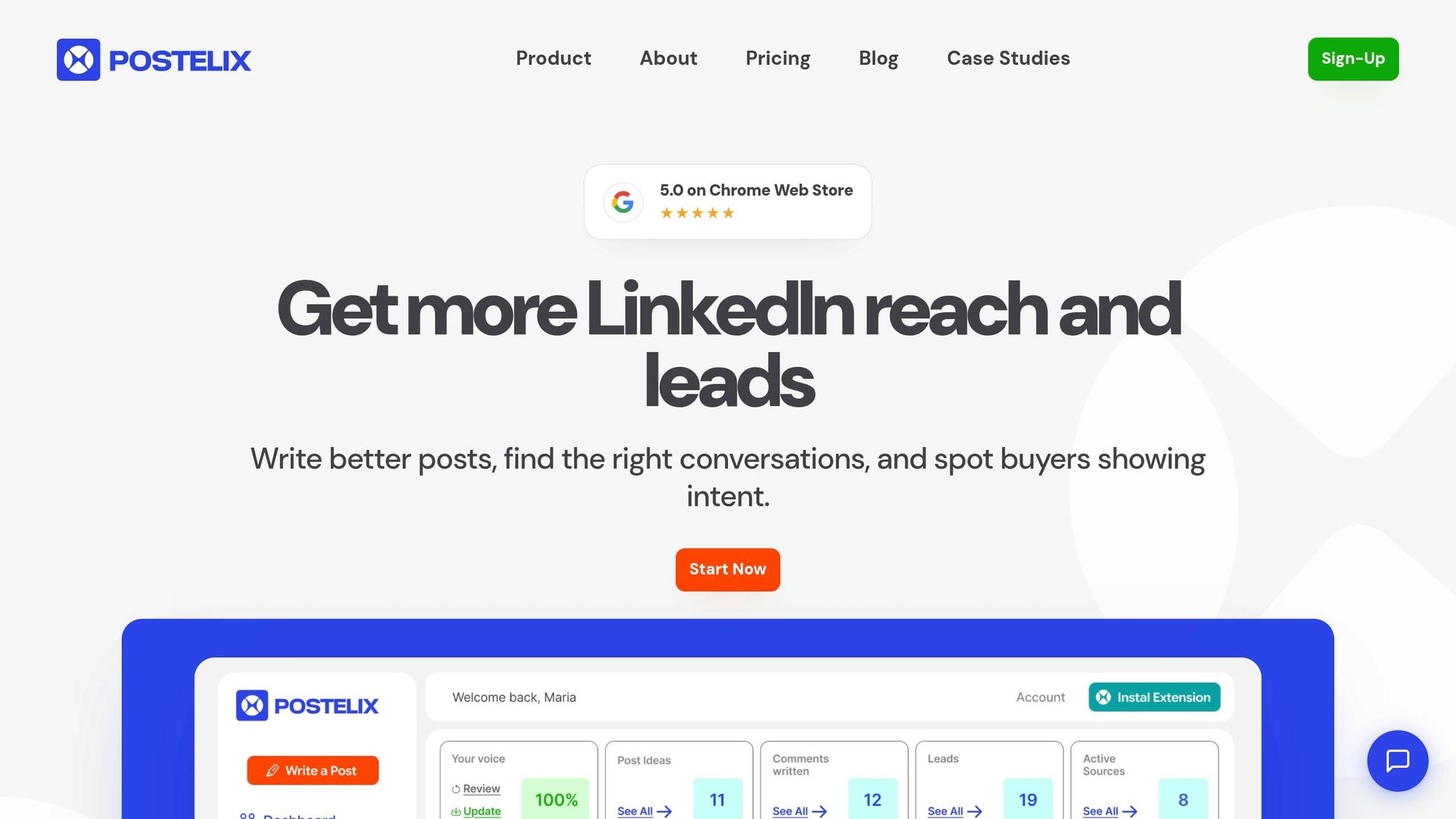
Postelix strikes a balance between personalization and scalability for LinkedIn outreach. It focuses on intent-based engagement, replicating natural LinkedIn behavior while targeting prospects who display clear buying signals - like hiring announcements, funding rounds, or tech updates. By using machine learning, it filters prospects based on your Ideal Customer Profile (ICP), ensuring your outreach feels relevant from the outset. This targeted strategy lays the groundwork for features designed to boost both efficiency and personalization.
One standout feature is Postelix’s AI system, trained specifically in your brand voice. It creates posts and comments tailored to each prospect using over 75 data points, such as job titles, recent news, and shared connections. The result? Messages that feel genuinely human. Plus, it can pull content from your own resources - like PDFs, videos, or web links - to craft posts and carousels that align with your brand.
The platform also addresses LinkedIn's evolving compliance standards for 2026. By using OAuth and LinkedIn-approved scheduling methods, it eliminates the risks of account suspension that older tools faced. With LinkedIn now applying dynamic daily limits (10–30 actions) tied to behavioral scores, Postelix keeps your account active and healthy.
Key Postelix Features for Outreach
Postelix is packed with features that streamline and enhance your LinkedIn outreach.
- 24/7 Hot Lead Agent: This tool monitors up to 10 competitor accounts and 10 intent keywords, delivering 25–50 qualified leads daily. It identifies prospects actively researching specific topics or undergoing tech changes.
- Advanced Lead Scoring System: It prioritizes leads based on urgency. For example, if a prospect just raised funding or shared a relevant pain point, the system flags them for immediate manual follow-up, bypassing generic sequences.
- AI-Generated Content Creation: Beyond direct messages, Postelix helps you stay visible by consistently posting and commenting on prospect activities. This builds an "authority-led warming" effect, making your eventual connection requests feel more natural since prospects are already familiar with you.
- DM Writer Assistant: Available with the Growth plan and higher, this feature helps draft personalized messages as conversations shift from automation to manual. It references specific details about the prospect, ensuring a smooth transition and a more human touch.
Combining Postelix with Manual Strategies
For 2026, the best outreach strategy is the "Sandwich Method" - automating routine tasks while reserving high-stakes interactions for manual effort. Postelix takes care of research, discovery, and warming, leaving you to focus on personal connection requests and closing conversations.
Here’s how you can use this hybrid approach:
- Automate list-building and profile visits to identify prospects showing buying signals. For those with high lead scores or in smaller markets (under 2,000 Total Addressable Market), switch to manual mode. Send connection requests with a brief, personalized note referencing their recent activity.
- When a prospect connects but remains silent, use Postelix to schedule a value-driven drip sequence. Share helpful resources or insights instead of pushing for meetings. Once the prospect responds, pause automation and take over manually.
- For high-value leads flagged by Postelix - like someone hiring for a role you can support or announcing a new initiative - switch to manual outreach immediately. These moments call for human judgment to avoid coming across as impersonal.
Teams using this mix of automation, manual touchpoints, and authority-building tactics report closing 34% more deals compared to fully manual teams.
Postelix also simplifies maintaining visibility. Its post scheduling and memory features allow you to stay active during your prospects’ peak hours. Meanwhile, AI-generated comments keep you engaged in relevant conversations. This hybrid workflow achieves response rates between 20% and 35%, operating at five times the scale of purely manual outreach.
How to Choose the Right Approach for Your B2B Goals
Selecting the best outreach strategy for your B2B goals depends on factors like deal size, market scope, and the trustworthiness of your account. Here's how to tailor your approach to maximize results.
For enterprise-level contracts over $50,000, manual outreach is a must. These high-value deals demand trust and personalization that only a human touch can provide. On the other hand, if your average contract value is under $5,000 and your target audience exceeds 10,000 prospects, automation is the way to go. It ensures the consistency and scale needed to engage a large pool of potential leads effectively.
Account trust plays a major role, too. If your LinkedIn profile is new or has low engagement, manual efforts are safer. LinkedIn’s dynamic limits restrict actions to 10–30 daily for such accounts, and profiles flagged for obvious automation are five times more likely to face restrictions.
A hybrid approach, often referred to as the "Sandwich Method", can yield the best results. This method combines the strengths of both strategies: automation for tasks like prospecting, list-building, and initial engagement, and manual outreach for critical interactions. For example, when reaching out to C-suite executives or highly engaged prospects, switching to a personal touch can make all the difference. This blend often leads to standout outcomes.
"The real question isn't automation versus manual. It's how you combine them." – Sbl.so
For high-stakes scenarios, like targeting automation-savvy buyers (think CTOs or founders) or working within smaller markets (fewer than 2,000 companies), manual outreach is the smarter choice. Prospects in these categories are quick to dismiss generic, templated messages, so a personalized approach is essential. Automation can still play a role here, but mainly for data collection and increasing visibility. When it comes to pitching and building relationships, personal interaction is key.
Ultimately, the right method depends on your deal size, market scope, and account trust. By aligning your strategy with these factors, you'll set yourself up for LinkedIn outreach success.
FAQs
How can I automate LinkedIn outreach without risking account restrictions?
To automate LinkedIn outreach safely, it's important to stick to strategies that align with LinkedIn's guidelines. Keep your daily actions within a reasonable range - typically between 10 and 30 actions, depending on your account's trust score. This helps avoid triggering LinkedIn's spam filters.
Use tools designed to replicate natural human behavior, and monitor your engagement levels regularly. A balanced approach that combines automation with manual efforts, such as customizing your messages, not only protects your account but also builds genuine connections. Steer clear of spammy practices to minimize the risk of account restrictions.
What’s the easiest way to personalize automated messages so they don’t feel fake?
To create automated messages that feel genuine, include personalized details such as the recipient’s recent activities, shared connections, or common interests. Use a friendly, conversational tone that feels natural, steering clear of anything that seems overly generic or spam-like. By keeping messages short, meaningful, and relatable, you can make them feel customized while fostering trust and encouraging engagement.
How do I decide which leads should switch from automation to manual outreach?
When trust and a personal touch are priorities - especially with high-value prospects - it’s time to shift from automation to manual outreach. Look for clues like low response rates, generic interactions, or signs that a lead is actively engaging with you, such as profile visits or replies.
Manual outreach becomes even more critical if automation risks making your communication feel inauthentic or could harm trust. By focusing on building relationships and responding thoughtfully, you can decide when personal effort will make the biggest impact.