
If you want to turn LinkedIn into a reliable source of leads, you need a system, not just effort. This 30-day guide breaks down a clear process using the E³ Model: Expertise (show authority), Evidence (share proof), and Engagement (build relationships). Here's the plan:
- Week 1: Optimize your profile and define your niche. Your profile should act as a landing page with a strong headline, clear CTA, and professional photo. Narrow your audience to a specific group for better targeting.
- Week 2: Post 3x weekly. Share proof-based content (case studies, metrics) and focus on engagement metrics like saves and comments.
- Week 3: Use tools like LinkedIn Sales Navigator to find leads based on job changes, funding news, or intent signals. Offer gated content (e.g., playbooks) to capture high-quality leads.
- Week 4: Personalize outreach with messages tailored to roles, companies, and trigger events. Track metrics like acceptance and reply rates to refine your process.
LinkedIn leads from inbound authority close at 14.6% versus 1.7% for cold outreach. By following this plan, you'll build a repeatable pipeline that delivers results.
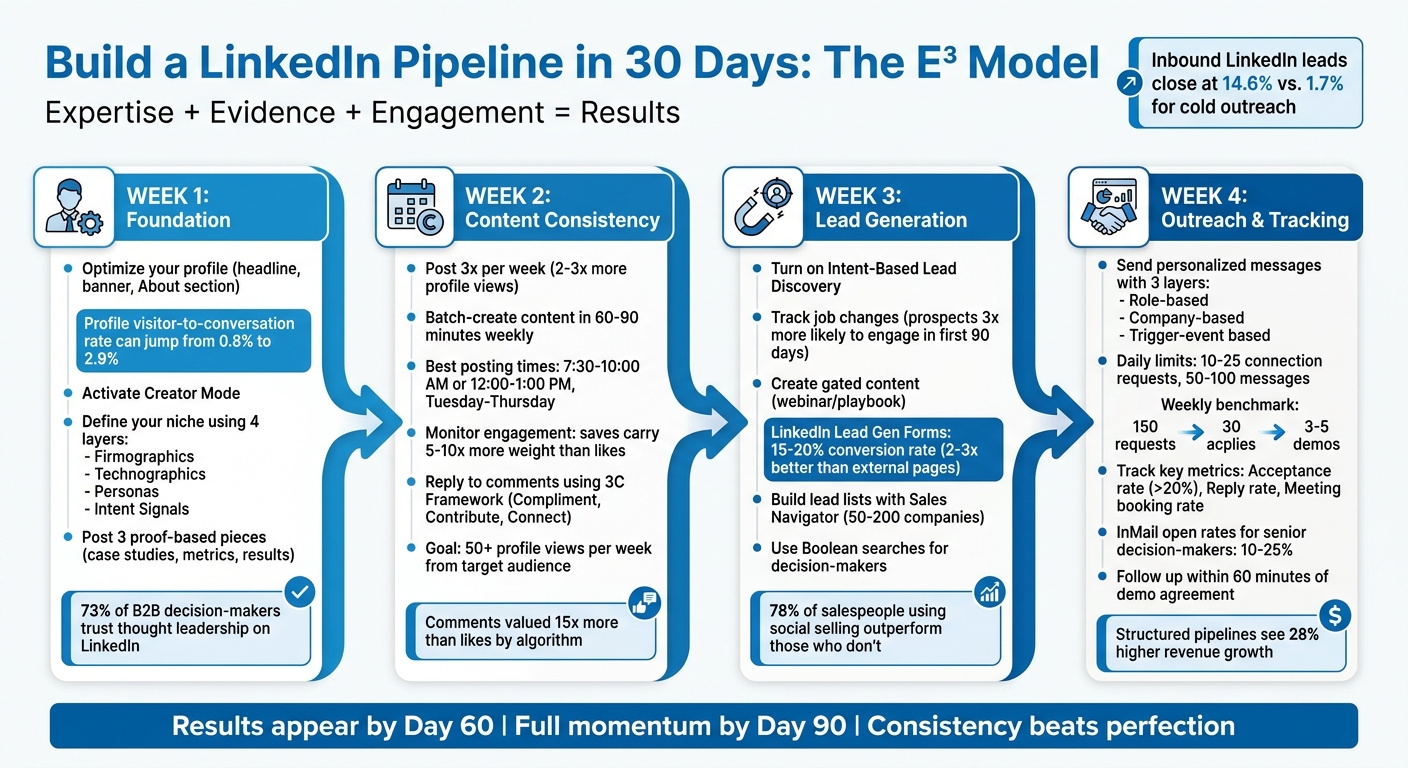
30-Day LinkedIn Pipeline Building Roadmap with Weekly Action Steps
Week 1: Set Up Your Profile and Choose Your Target Audience
Update Your LinkedIn Profile
Think of your LinkedIn profile as your 24/7 landing page - not just a resume. Visitors form an impression in just 3–6 seconds, so every detail needs to work toward building trust and driving engagement.
Start with your headline. Ditch generic titles like "Founder at [Company Name]" and use a value-packed formula: Target Audience + Specific Outcome + Method. For instance, instead of "Marketing Consultant", try "B2B SaaS CMOs → 3x Pipeline in 90 Days Through LinkedIn Authority." Remember, the first 60 characters are key for mobile users.
"If your headline says 'Founder at [Company Nobody's Heard Of],' you're paying for the most expensive billboard LinkedIn can give you and wasting the impression." - Carolina Posma, Postiv AI
Next, optimize your banner. Include a clear call-to-action (CTA), client logos, ratings, or even a product screenshot with a URL. Make sure the text is bold and easy to read on mobile, where most LinkedIn traffic happens.
In the About section, focus on converting visitors rather than just summarizing your career. Structure it like this:
- Start with a hook that addresses a common pain point for your audience.
- Promise a measurable transformation.
- Support your claims with proof, like metrics or testimonials.
- End with a straightforward CTA.
Here’s an example of the impact this approach can have: In Q2 2025, a VP of Sales at a $90M ARR cybersecurity company revamped their profile using this method. Their visitor-to-conversation rate jumped from 0.8% to 2.9% in just 90 days, leading to 8 additional qualified conversations per month.
Activate Creator Mode to make "Follow" the primary action button instead of "Connect." This makes it easier for prospects to engage with your content without feeling pressured. Also, don’t underestimate the power of a professional photo. Profiles with high-quality headshots attract more views and connection requests. Aim for a high-resolution image with 60% face composition, direct eye contact, and a welcoming smile.
Choose Your Specific Niche
Broad targeting like "SaaS founders" won’t cut it. Narrow your focus to something like "B2B SaaS founders generating $2M–$8M ARR and struggling with outbound consistency in the US market". Precision is key to generating high-quality leads.
"Reach is not the variable. Relevance is." - Konnector.ai
To define your niche, consider these four layers:
- Firmographics: Industry, company size, and location.
- Technographics: Tools or platforms they use (e.g., "Companies using Salesforce").
- Personas: Job titles, seniority levels, and years of experience.
- Intent Signals: Indicators like recent funding, hiring activity, or role changes in the last 90 days.
Fun fact: Prospects who’ve changed roles in the last 90 days are 3x more likely to engage with outreach. Use Boolean search operators like AND, OR, and NOT (e.g., Marketing NOT Intern) to filter out irrelevant profiles and focus on decision-makers.
With your profile polished and your niche locked in, you’re ready to start sharing content that establishes your authority.
Publish Proof-Based Content with Postelix
Now it’s time to back up your expertise with proof. Authority isn’t about saying you’re great - it’s about showing it. Start by posting three proof-based pieces in your first week. These could include:
- Client case studies
- Revenue milestones
- Growth metrics
- Before-and-after results
Tools like Postelix's Voice Personalization can help you quickly capture insights after client calls. Save screenshots, testimonials, and data in the Source Library so you can easily incorporate them into posts later. Stick to the 80/20 rule: make 80% of your content valuable or informative, while keeping promotion to just 20%.
Keep in mind, LinkedIn’s algorithm gives 5–10x more weight to content saves than to likes. Focus on creating tactical "how-to" posts, data-driven insights, or personal stories that resonate with your niche. Consistency in posting builds "micro-familiarity," which makes prospects more likely to accept connection requests because they already associate you with expertise.
And here’s a stat to keep you motivated: 73% of B2B decision-makers trust thought leadership on LinkedIn more than traditional marketing materials.
sbb-itb-f8f3793
Week 2: Build a Posting Schedule and Find What Works
Post Three Times Per Week
Now that you've nailed down your profile and niche in Week 1, it’s time to focus on consistency. Posting three times a week can lead to 2–3x more profile views compared to posting just once. And don’t worry - this doesn’t mean spending hours every day writing. Instead, set aside 60–90 minutes once a week to batch-create your posts. This method not only saves 4–6 hours but also helps you avoid the stress of daily decision-making.
To keep your content engaging, mix up your formats. For example:
- On Mondays, share a personal story that teaches a lesson.
- On Tuesdays and Thursdays, post tactical advice with actionable steps.
- On Wednesdays, offer a strong opinion to spark discussions.
This kind of structure keeps your feed interesting and ensures you’re not scrambling for ideas each day.
Tools like Postelix AI can make this process even smoother. Use features like Voice Personalization to quickly capture ideas after client meetings and turn them into polished posts. Store key data, screenshots, and case studies in the Source Library to easily add credibility to your content. And for timing? Aim to post between 7:30 AM and 10:00 AM or during lunch hours (12:00 PM to 1:00 PM) on Tuesday through Thursday, when engagement tends to peak.
"Consistency beats quality. The founder who posts 3 times per week for 6 months will outperform the founder who writes one 'perfect' viral post and then disappears." - LinkPilot
Monitor Engagement to Find Top Posts
LinkedIn’s algorithm now favors depth signals - things like how long people spend reading your post, clicking "see more", or engaging in the comments - over simple likes. Pay attention to metrics like saves and DM shares, as these carry more weight than likes. Posts using carousels or documents also tend to perform well, with an average engagement rate of 7.00%, the highest among content formats.
Another key metric is your comment rate. A healthy rate is anything above 0.3% (calculated as comments divided by impressions). Keep a close eye on the first hour after posting, as most posts that underperform early rarely recover later.
Set a goal of 50+ profile views per week from your target audience. Use tools like Postelix's analytics to track weekly metrics, including profile views, connection requests, and meaningful DM conversations. This will help you identify patterns in what resonates most with your niche.
Reply to Comments with Personalized Responses
Engaging with comments is a powerful way to boost visibility. In fact, strategic commenting can drive 5x more profile views than just posting alone. When replying to comments, use the 3C Framework:
- Compliment the commenter with specific praise.
- Contribute by sharing a unique insight or experience.
- Connect by asking a follow-up question to keep the conversation going.
This approach can increase comment engagement by 400% compared to generic responses like "Great post!" or "Agree!". Dedicate 10–20 minutes daily to replying thoughtfully. Tools like Postelix AI comments can help draft initial responses in your voice, which you can then personalize with relevant insights or data.
Once a comment thread gains traction, consider moving the conversation to direct messages. Offer a resource or framework that adds value. And remember, LinkedIn’s algorithm values comments 15x more than likes, so aim to respond within 24 hours to keep the momentum alive. Thoughtful interactions not only build relationships but also lay the foundation for turning engaged prospects into clients in the weeks ahead.
Week 3: Find Leads and Create Gated Content
Turn On Intent-Based Lead Discovery
It's time to start identifying potential buyers using intent signals. Postelix's Intent-Based Lead Discovery tool monitors key indicators like job changes within the last 90 days, LinkedIn activity over the past month, and whether prospects are following your company.
Why focus on job changes? Prospects who recently switched roles are 3x more likely to engage with outreach. They’re often evaluating new vendors and managing fresh budgets. To stay ahead, set up saved searches in Sales Navigator to track profiles that match your Ideal Customer Profile (ICP). This creates a steady stream of pre-qualified prospects without constant manual effort. Spend just 15 minutes a day reviewing alerts for job changes or news mentions. Then, sort leads into categories like "act now", "act soon", or "watch" for better prioritization.
Another great tactic is to watch for trigger events like funding announcements, company growth, or specific department hiring. Outreach personalized around these events can lead to 3x higher reply rates. And don’t forget: 78% of salespeople using social selling outperform those who don’t. With these leads in hand, the next step is offering them something they can’t resist - custom content that speaks directly to their needs.
Create a Webinar or Playbook
Once you’ve identified active prospects, you’ll want to reel them in with gated content. Gated assets - like a playbook, swipe file, or mini-course - are perfect for converting engaged followers into qualified leads. LinkedIn Lead Gen Forms are particularly effective, delivering conversion rates of 15% to 20% and performing 2–3x better than external landing pages thanks to their auto-filled user data.
Here’s a clever trick: use a "comment-to-receive" strategy instead of posting direct download links. For instance, ask readers to comment "Playbook" or "Guide" to receive the asset via DM. This not only boosts your post’s visibility on LinkedIn but also helps identify high-intent leads. Try crafting an eye-catching hook like, "99% of founders chase engagement and end up broke - here’s the system that actually works", to grab attention and encourage interaction.
If you're using Postelix, take advantage of its Lead Magnets feature, which lets you create up to five lead magnets per month (on the Pipeline plan) with built-in lead capture pages[website]. Pin your best-performing asset to your LinkedIn Featured section to make it easily accessible to profile visitors. When someone requests your playbook, follow up with a simple qualifying question: "Are you just here for the content, or is [Topic] something you're actively working on?". This helps you separate casual browsers from serious buyers.
Build Lead Lists with Sales Navigator
Sales Navigator makes it easy to turn broad searches into laser-focused lead lists. Start by creating account lists of 50–200 companies that match your ICP. Consider factors like industry, company size, location, and revenue. Then, build lead lists of decision-makers at these companies using Boolean filters and intent signals.
To capture variations in job titles, use Boolean search terms. For example, searching ("RevOps" OR "Revenue Operations") AND (Director OR VP) ensures you include all relevant decision-makers. Add filters like recent job changes or LinkedIn activity to prioritize prospects who are more likely to respond.
Save time by using the bulk selection feature to add entire pages of search results in seconds. Most Sales Navigator plans allow you to create up to 50 lead lists and 50 account lists, with a maximum of 1,500 leads per list. Sync Sales Navigator with your CRM (like Salesforce or HubSpot) to automatically log activity and prevent duplicate outreach to existing customers. This approach keeps your pipeline clean and organized, setting you up for success as you transition into Week 4’s outreach strategies.
Week 4: Connect with Leads and Track Results
Send Personalized Offers to Engaged Leads
Now that you’ve identified warm leads from Week 3, it’s time to turn that engagement into action. The key to effective outreach is personalization. The best LinkedIn messages include three layers of customization:
- Role-based: Address challenges specific to their position.
- Company-based: Relate to their industry or recent developments.
- Trigger-event based: Reference timely actions like job changes or funding news.
For instance, if someone recently switched roles, you might say: "I noticed your team just expanded into the UK. Growing teams often face [specific challenge]. Is that something you’re focusing on?" This approach works because people in new roles are 3x more likely to respond within their first 90 days.
To make crafting these messages easier, tools like Postelix’s DM Writer Assistant (Growth plan) or Full DM Writing System (Pipeline plan) allow you to reference profile activity or recent posts. For example, if a prospect viewed your profile, you could start with: "I saw you checked out my profile - what stood out to you?". Avoid overused openers like "I hope this finds you well" or "Quick question", as these can trigger spam filters with seasoned buyers. Instead, keep the tone casual and end with low-pressure asks like, "Would a 15-minute chat work this week?" instead of formal phrases like "book a consultation".
Once a prospect agrees to a demo, send your booking link within 60 minutes to capitalize on their interest. Follow up strategically with "If/Then" sequences: for example, if someone doesn’t reply to your initial message, send a case study three days later. Keep outreach safe by limiting yourself to 10–25 new connection requests and 50–100 messages to existing connections daily, avoiding LinkedIn restrictions.
Measure Your Pipeline Performance
It’s important to give your LinkedIn pipeline time to stabilize - don’t expect reliable metrics in the first 30 days. By around day 60, you’ll have a clearer picture for forecasting. Focus on tracking both inputs (outreach volume, connection requests) and outputs (demo bookings, closed deals) to pinpoint areas that need adjustment.
Here’s what a well-run LinkedIn playbook can deliver weekly for a single person: 150 connection requests, leading to ~30 accepts, ~11 replies, and 3–5 demo bookings.
Postelix’s Advanced Lead Scoring feature (Pipeline plan) can help you analyze lead quality and prioritize follow-ups. Sync your intent leads with your CRM, using fields like Campaign_Source or ICP_Fit_Score to tie revenue back to specific LinkedIn workflows.
Key metrics to monitor:
- Acceptance rate: Below 20% may signal issues with targeting or your profile.
- Reply rate: High acceptance but low replies? Messaging might need tweaking.
- Meeting booking rate
- InMail open rates: Senior decision-makers typically see 10%–25% open rates.
Calculate your conversion ratios. For example, if five conversations usually lead to one meeting, you can set clear activity goals based on that ratio. Tools like Sales Navigator Smart Links can also track which parts of your shared content (e.g., pricing slides) prospects are engaging with most. Use these insights to refine your approach.
Adjust and Grow Your Approach
By this point, your pipeline data should highlight areas for improvement. After 60 days, start optimizing by regularly cleaning your pipeline. Remove deals that have been stagnant for more than twice your average sales cycle and withdraw LinkedIn requests older than three weeks. This keeps your focus sharp and forecasts accurate.
Revisit your qualification criteria to ensure you’re not wasting time on leads who aren’t likely to convert. You can also refine your targeting with a "warm-up" routine: view a prospect’s profile on Day 1, like a post on Day 2, and leave a comment on Day 3 before sending a connection request. This gradual engagement builds familiarity and improves acceptance rates.
Companies with structured pipelines see 28% higher revenue growth compared to those with informal processes. Document what’s working and create repeatable workflows. Tools like Postelix’s 24/7 Hot Lead Agent (Pipeline plan) can track up to 10 competitor accounts and 10 intent keywords, delivering 25–50 intent leads daily.
As you scale, remember that inbound leads from content efforts close at 14.6%, compared to just 1.7% for cold outbound leads. Consistently publishing valuable content alongside your outreach ensures LinkedIn becomes a steady source of revenue. The formula is simple: combine regular posting, intent-based targeting, and personalized follow-ups to maximize results.
My BEST LinkedIn Strategy for Lead Generation (w/ Natasha Vilaseca)
Conclusion
This guide has laid out a clear, step-by-step approach to building your LinkedIn pipeline. While a 30-day plan is a great start, the real momentum builds over 90 days. The first month is all about setting the groundwork - fine-tuning your profile, sharing consistent content, and initiating personalized outreach. However, it takes about three months for your pipeline to stabilize and start delivering consistent results.
"What separates confident growth from unpredictable chaos on LinkedIn is not your content or connections, but the invisible system behind your sales pipeline." - Pursuitz
Once you’ve established these foundational habits, the focus shifts to tracking actionable outputs. Success on LinkedIn isn’t about obsessing over closed deals but about measuring the right inputs. Actions like sending tailored messages, researching qualified leads, and publishing relevant content are what drive results. Understanding conversion ratios - like how five conversations typically lead to one meeting - turns LinkedIn growth into a numbers game you can control.
Consistency is the key to success. Sales professionals who embrace social selling are more likely to hit their targets, with 74% of buyers preferring reps who prioritize delivering value upfront. Tools such as Postelix can make this process easier by automating tasks like finding intent-based leads, creating personalized content, and tracking engagement. This frees you up to focus on what matters most - building genuine relationships.
Treat your LinkedIn outreach as a non-negotiable part of your schedule, just like important client meetings. Avoid falling into the trap of inconsistent, stop-and-start activity. By sticking to this disciplined approach, you’ll reinforce the strategies outlined here and turn your LinkedIn efforts into a reliable source of revenue. The pipeline you create in these 30 days is just the beginning, paving the way for steady, long-term growth.
FAQs
What should I do if my acceptance rate stays under 20%?
If your acceptance rate on LinkedIn is sitting below 20%, it's time to revisit your outreach approach. Start by personalizing connection requests - a generic message won't cut it. Tailor your outreach to resonate with each recipient. Next, refine your targeting strategy to ensure you're reaching the right audience.
Don’t forget to craft structured follow-up messages that add value and keep the conversation going. Also, take a close look at your LinkedIn profile. Make sure it's polished, professional, and aligned with the interests of your target audience.
By consistently applying these tactics and tweaking your approach based on feedback, you can steadily improve your acceptance rate over time.
How can I create proof-based posts if I don’t have case studies yet?
If you don’t have formal case studies, there are still plenty of ways to show your expertise. Share insights or lessons you've learned from your own experiences or experiments. Even small wins, data points, or key observations can go a long way in demonstrating your knowledge.
Another option? Engage with relevant industry trends or blog posts. Offer thoughtful commentary or unique perspectives to add value. These strategies help establish credibility and build trust, even without traditional case studies in your portfolio.
How do I turn engagement into booked meetings without sounding salesy?
To turn engagement into booked meetings without coming across as pushy, prioritize building trust and offering real value. Share content that’s genuinely helpful, leave thoughtful comments on your prospects’ posts, and address their challenges in a way that feels sincere. Instead of relying on generic pitches, craft personalized messages that focus on building relationships. This strategy helps establish your credibility and encourages prospects to respond positively, boosting your chances of meaningful interactions and eventual meeting bookings.