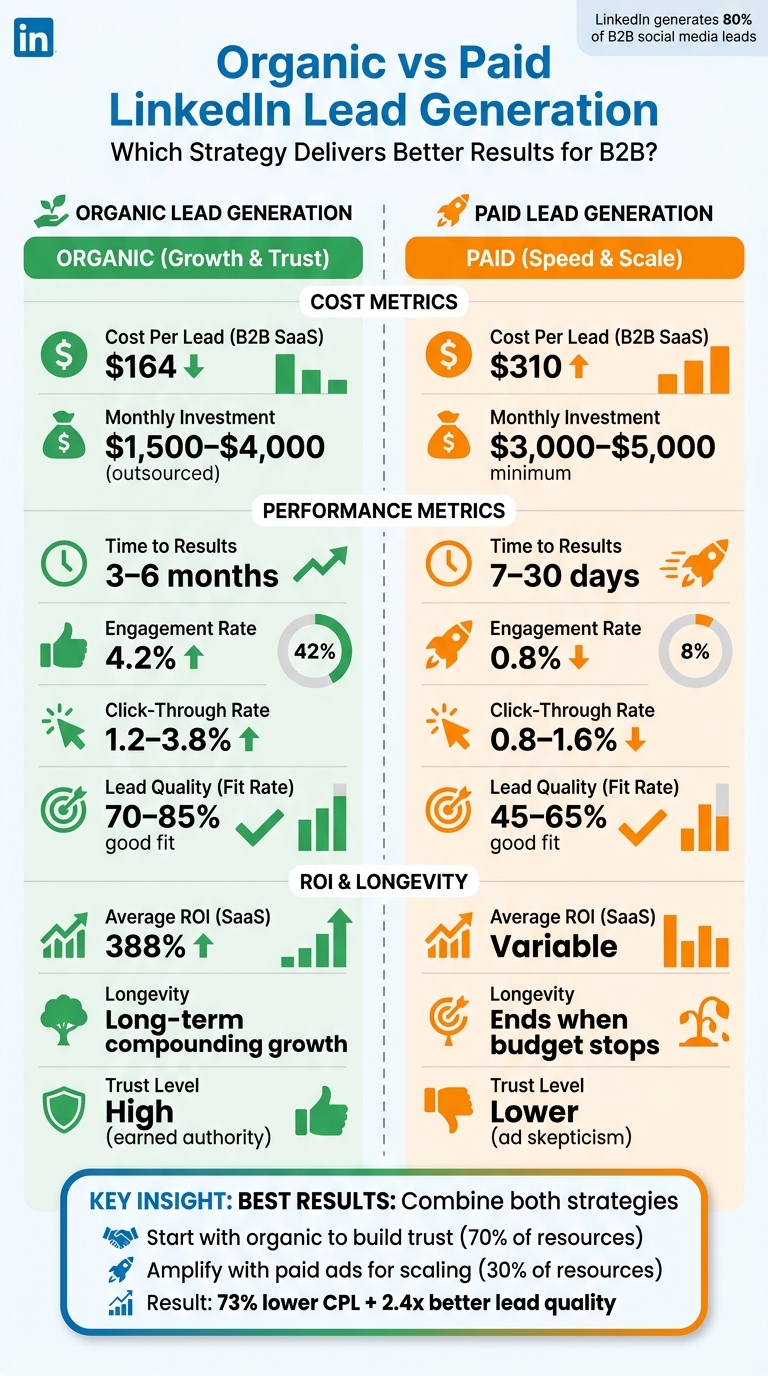
LinkedIn is the top platform for B2B lead generation, responsible for 80% of all B2B social media leads. But which approach works better: organic or paid lead generation? Here’s a quick breakdown:
- Organic Lead Generation: Focuses on building relationships through personal posts, engagement, and profile optimization and intent-led growth. It’s cost-effective over time, with an average cost per lead of $164 for B2B SaaS companies. However, it requires consistent effort (6–10 hours per week) and takes 3–6 months to show results.
- Paid Lead Generation: Uses LinkedIn ads like Sponsored Content and Message Ads for immediate results. It’s precise but expensive, with costs ranging from $150–$400 per lead and a minimum monthly budget of $3,000–$5,000. Results are fast (within 7–30 days) but stop when the budget ends.
Quick Comparison
| Metric | Organic | Paid |
|---|---|---|
| Cost Per Lead (B2B SaaS) | ~$164 | ~$310 |
| Time to Results | 3–6 months | 7–30 days |
| Engagement Rate | 4.2% | 0.8% |
| Monthly Cost | $1,500–$4,000 (outsourced) | $3,000–$5,000 minimum |
| Lead Quality | 70–85% good fit | 45–65% good fit |
| Longevity | Long-term growth | Ends with budget |
Key Insight: Combining both strategies often delivers the best results. Start with organic to build trust, then amplify with paid ads for faster scaling and better ROI.
Organic vs Paid LinkedIn Lead Generation: Complete Comparison of Costs, Performance & ROI
Cost Analysis: Organic vs Paid
What Organic Lead Generation Costs
Growing your audience organically means dedicating about 6–10 hours per week to activities like creating content, optimizing profiles, and engaging with others online. On average, this involves posting 3–4 times weekly and interacting with 20–50 posts daily to stay visible in the algorithm.
If you choose to outsource this work, expect to pay $1,500 to $4,000 per month. Specialized outreach services start at $397 per month. For executives with high hourly rates - say $100 per hour - the time spent manually networking can quickly add up to a higher cost than running ads.
However, organic leads are generally more affordable. For B2B SaaS companies, the average cost per organic lead is $164, which is 47% less than the $310 average cost per lead for paid ads. Plus, organic LinkedIn efforts in the SaaS industry deliver an impressive 388% ROI on average.
Now, let’s shift gears and look at the financial commitment required for paid strategies.
What Paid Lead Generation Costs
Paid campaigns, unlike organic methods, require a substantial budget. Running a basic LinkedIn advertising test typically costs $3,000–$5,000 per month. For companies aiming to scale, some agencies recommend allocating $30,000 or more per month.
LinkedIn advertising is known for its high price tag. The average Cost Per Click (CPC) in the U.S. is $8–$10, with some B2B industries paying between $5 and $15. For industries like SaaS and finance, Cost Per Mille (CPM) ranges from $33 to $65, while Cost Per Lead (CPL) generally falls between $150 and $400. In some cases, companies report spending $500–$750 just to book a single sales call.
"LinkedIn is the most expensive major ad platform. Full stop. CPMs typically run $6 to $12. Cost-per-click regularly hits $5 to $15 for B2B audiences."
- Rohan Pavuluri, Creator of TeamPost
The downside of paid strategies is that they’re temporary - you’re essentially “renting” an audience. Once your budget stops, so do the results.
Here’s a side-by-side comparison to break down the costs further.
Cost Comparison Table
| Metric | Organic Lead Generation | Paid LinkedIn Ads |
|---|---|---|
| Average Cost Per Lead (B2B SaaS) | ~$164 | ~$310 |
| Key Investment | Time & Expertise (6–10 hrs/week) | Financial Capital ($3,000–$30,000+/month) |
| Monthly Cost (Outsourced) | $1,500–$4,000 | $3,000–$5,000 minimum |
| Time to Results | 90–180 days | 7–30 days |
| Engagement Rate | 2–6% | 0.4–0.6% |
| Asset Value | Compounding equity | Rented audience |
| Lead Quality | 70–85% good fit | 45–65% good fit |
sbb-itb-f8f3793
Performance Metrics: Engagement and Conversion Rates
Organic Engagement and Conversions
Organic LinkedIn posts boast an average engagement rate of 4.2%, significantly outpacing paid ads, which average just 0.8%. That’s more than five times higher. Why such a stark difference? It comes down to trust. When people encounter content shared by individuals offering genuine insights or personal experiences, they’re much more inclined to engage. Compare this to posts marked with a "Promoted" tag - many decision-makers have developed "ad blindness", where they instinctively overlook sponsored content.
Click-through rates (CTR) tell a similar story. Organic posts typically achieve CTRs between 1.2% and 3.8%, while paid ads tend to fall between 0.8% and 1.6%. Even more striking, visitors arriving via organic channels convert 2.4 times better than those from paid ads.
"A comment from a VP of Sales at a target account is worth more than 10,000 ad impressions." - Rohan Pavuluri, Creator of TeamPost
Organic leads also shine in terms of quality, with 70–85% of them being a "good fit". This reflects the trust and rapport built over time, as opposed to the colder approach of direct outreach. While paid campaigns might deliver leads faster, they often fall short in these key engagement metrics.
Paid Engagement and Conversions
Paid campaigns are all about speed, but they come with trade-offs in engagement and quality. LinkedIn ads, for instance, average an engagement rate of just 0.4% to 0.6%, far below the performance of organic content.
Many B2B buyers now actively skip over content marked as "Sponsored", viewing it as a distraction rather than a resource. This reduces trust and often means paid leads require more time and effort to nurture. Paid ads can generate a 2–5% click-to-lead conversion rate, but the quality of those leads varies significantly, with fit rates ranging from 45% to 65%. In other words, nearly half of the leads from paid campaigns might not align with your product or service.
However, paid ads do have one undeniable advantage: speed. You can launch a campaign and start generating leads within 24–48 hours. For businesses looking to quickly fill their sales pipeline or test a new market, this immediacy can be a game changer.
Engagement and Conversion Comparison Table
| Metric | Organic LinkedIn | Paid LinkedIn Ads |
|---|---|---|
| Average Engagement Rate | 4.2% | 0.8% |
| Click-Through Rate (CTR) | 1.2–3.8% | 0.8–1.6% |
| Conversion Multiplier | 2.4x higher than paid | Baseline |
| Lead Quality (Fit Rate) | 70–85% | 45–65% |
| Trust Level | High (earned authority) | Lower (ad skepticism) |
| Employee Content Boost | 8x more engagement | N/A |
Scalability, Speed, and Trust Factors
Organic: Long-Term Growth and Trust Building
Building organic growth on LinkedIn is like planting a seed - it takes time, but the rewards grow steadily. Every post, comment, and connection adds to your "reputation bank", gradually expanding your reach without adding to your expenses. However, patience is key. For most businesses, it takes 3–6 months to gain enough momentum to create a steady flow of leads.
The beauty of organic growth lies in its lasting impact. Unlike paid ads that disappear when the budget runs out, organic content sticks around. A well-crafted thought leadership post can continue to generate leads for months, even years. As your network and credibility grow, your lead generation becomes more efficient, offering long-term savings compared to paid strategies.
That said, organic growth requires a consistent time investment - around 1–2 hours daily for creating content and engaging with your audience.
"Organic LinkedIn is the foundation. LinkedIn Ads are the accelerator. Brands that win build trust before selling."
Paid: Fast Results and Linear Scaling
If you're looking for quick wins, paid campaigns on LinkedIn deliver almost instant results. Launch a campaign, and you could start driving traffic within 24–48 hours. This makes paid ads especially useful for time-sensitive efforts like promoting webinars or events.
Scaling paid campaigns is straightforward: the more you spend, the more people you can reach. However, this approach comes with a catch - once you stop paying, the traffic stops too. It's a "pay-to-play" model.
Trust can also be an issue with paid ads. Many B2B decision-makers have become adept at ignoring content tagged as "Promoted" or "Sponsored". As a result, engagement rates for paid ads (typically 0.4%–1.5%) are often lower than those for organic posts, which usually see engagement rates between 2% and 6%. With paid ads, you're essentially renting attention rather than earning it.
These differences highlight the importance of understanding how organic and paid strategies align with your goals. Knowing the strengths and limitations of each approach will help you make smarter decisions about where to focus your efforts and resources.
Speed, Scale, and Trust Comparison Table
| Factor | Organic LinkedIn | Paid LinkedIn Ads |
|---|---|---|
| Speed of Results | Slow (3–6 months for momentum) | Fast (24–48 hours) |
| Scalability | Compounding (grows with effort/network) | Linear (scales with budget) |
| Trust Level | High (earned authority) | Lower (perceived as "rented") |
| Longevity | Lasting impact | Ends when budget stops |
| Cost Per Lead (B2B SaaS) | ~$164 | ~$310 |
| Reach Potential | Limited to followers and their networks | Unlimited (criteria-based targeting) |
The Best LinkedIn Lead Generation Strategy for 2026
Choosing the Right Strategy for Your Business
This section dives into how to decide between organic, paid, or a mix of both LinkedIn strategies, based on your business goals, budget, and timeline.
The choice isn’t about picking one over the other - it’s about aligning the strategy with your specific needs. Factors like your available budget, how quickly you need results, and your overall objectives will guide the decision.
When to Use Organic Strategies
Organic LinkedIn strategies work best if you’re working with a monthly budget of less than $3,000 and have a sales cycle longer than 90 days. For example, organic efforts deliver a 70–85% rate of high-quality leads and help establish long-term credibility in your industry. On the other hand, LinkedIn ads typically require a budget of $3,000–$5,000 per month just to exit the "learning phase" and gather meaningful data.
For startups or businesses with average deal sizes under $5,000, organic strategies are a better fit financially. These approaches focus on building trust and thought leadership over time, which is especially valuable for enterprise B2B sales cycles that often exceed 90 days. The numbers back this up: organic LinkedIn campaigns can deliver an average ROI of 388% for SaaS companies, with leads costing about $164 each - significantly lower than the $310 average cost for paid leads.
However, if time is a critical factor and you need quick results, organic strategies may not be the best choice.
When to Use Paid Strategies
If speed is your priority, paid LinkedIn strategies are the way to go. Paid ads can start generating traffic within 24–48 hours, making them an excellent option for time-sensitive campaigns like webinars or product launches. Paid approaches are also ideal when your goal is to meet short-term revenue targets or quickly fill your pipeline.
High-ticket deals further justify paid campaigns. If your average contract value exceeds $10,000, the cost per lead (ranging from $150–$400) becomes more justifiable. Paid strategies also allow for precise targeting. For instance, Account-Based Marketing (ABM) campaigns can directly target specific job titles or companies - something organic efforts can’t achieve as effectively.
That said, paid campaigns require a solid budget and a proven offer. Businesses still refining their messaging should avoid heavy ad spending, as experimenting with untested creatives can quickly become costly. A minimum monthly budget of $3,000–$5,000 is essential to gather enough data for optimization.
Combining Both Methods for Better Results
The most effective approach often combines organic and paid methods. By starting with organic efforts and layering in paid ads later, businesses can reduce their cost per lead by up to 73%. Organic content helps warm up your audience, making paid campaigns more effective when introduced.
A three-step strategy works well: build credibility with organic posts, amplify successful content with paid ads, and drive specific actions like demo bookings with targeted campaigns. This hybrid approach can result in 2.4X higher lead quality and a 5.8X increase in lifetime value compared to relying solely on paid ads.
To strike the right balance, allocate about 70% of your social resources to organic efforts like brand building and thought leadership. Use the remaining 30% for paid campaigns focused on conversions and retargeting. Test headlines and formats through organic posts before committing ad dollars, ensuring your budget supports content that already resonates. This prevents wasted spend while maximizing the impact of your investment.
| Business Situation | Recommended Strategy |
|---|---|
| Budget under $3,000/month | Organic |
| Average deal size under $5,000 | Organic |
| Need leads within 30 days | Paid Ads |
| Building long-term authority | Organic |
| Targeting specific accounts (ABM) | Paid Ads |
| Proven offer ready to scale | Hybrid (Ads + Organic) |
How Postelix Supports Organic LinkedIn Lead Generation
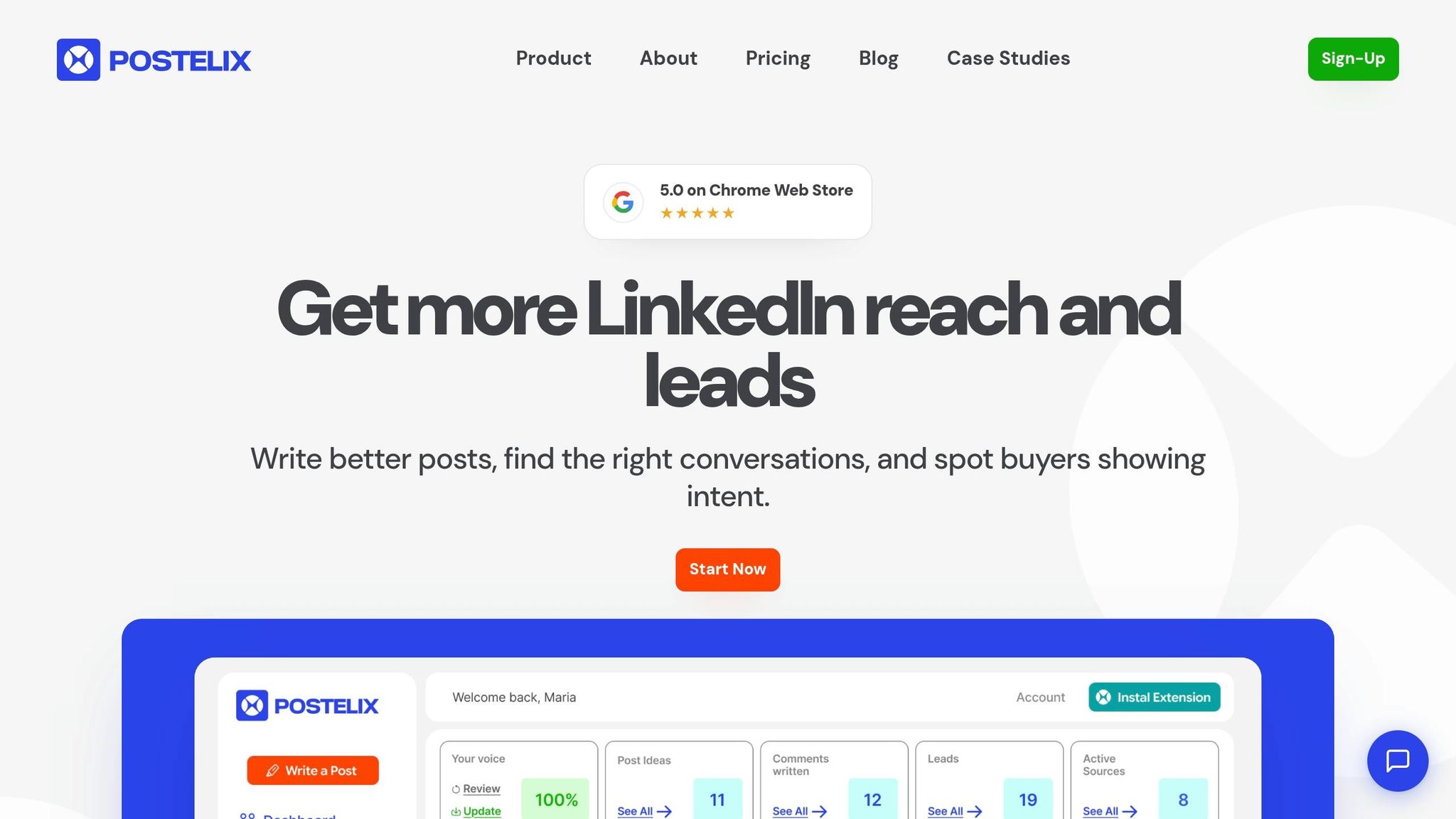
Organic lead generation is a great way to build trust and credibility over time, but it often requires a significant time investment. For B2B professionals, this can mean spending 1–2 hours daily engaging on LinkedIn - posting several times a week and commenting on dozens of posts. That’s where Postelix steps in. It automates key tasks, saving you hours while keeping the personal touch that makes LinkedIn so effective. Here’s how Postelix simplifies the process.
Key Features of Postelix
Postelix uses AI to make content creation and lead discovery faster and easier. Its AI analyzes the sentiment and context of posts, generating tailored responses and posts that help you stay active on LinkedIn without the stress of writer’s block.
The platform also excels at finding leads. By scanning LinkedIn for potential clients who’ve shared specific challenges, Postelix creates ready-to-message prospect lists in just minutes. It identifies real-time intent signals - like role changes (which can make prospects three times more likely to engage), profile views, and other interactions - so you can reach out at the right moment. This automation reduces manual effort from 6–8 hours a month to just 2–4 hours.
Another standout feature is voice personalization. Postelix learns your writing style and applies it consistently across posts and comments, ensuring your content feels authentic and aligned with your personal tone.
Postelix Pricing and Plans
Postelix offers three pricing tiers tailored to different growth needs:
- Starter Plan ($34/month): Includes 30 AI-generated posts, 60 AI comments, comment suggestions, a personalized voice profile, and post scheduling.
- Growth Plan ($86/month): Adds 60 AI posts, 150 AI comments, daily lead suggestions, and two lead magnets with capture pages.
- Pipeline Plan ($217/month): Provides 100 AI posts, 300 AI comments, and a 24/7 Hot Lead Agent that tracks up to 10 competitor accounts and 10 intent keywords, delivering 25–50 high-intent leads daily.
Each plan supports one LinkedIn profile and includes CSV export functionality for easy lead management. These options let you scale your LinkedIn efforts without the heavy time commitment.
Turning LinkedIn Activity into Pipeline Growth
Postelix doesn’t just help you stay active on LinkedIn - it turns that activity into meaningful pipeline growth. By tracking key metrics like profile views from target accounts and connection requests from your Ideal Customer Profile (ICP), the platform ensures your efforts translate into results.
Timely engagement is crucial for converting prospects, and Postelix helps you act fast by identifying buying signals and giving you the context needed for personalized outreach. Its Chrome extension makes it easy to engage directly within LinkedIn, while the DM Writer Assistant (available in the Growth and Pipeline plans) helps transform intent signals into conversations in just minutes.
With Postelix, you’re not just automating tasks - you’re creating opportunities for real business conversations.
Conclusion: Which Strategy Works Better?
There’s no one-size-fits-all answer here - it all comes down to your budget, timeline, and business goals. For example, if your monthly marketing budget is under $3,000, organic strategies tend to be the smarter choice. Smaller budgets often struggle to get past LinkedIn’s learning phase effectively. On the other hand, if you need leads quickly - within 7 to 30 days - and have the budget to support it, paid ads can deliver results fast.
That said, the real magic happens when you combine both approaches. Organic engagement can actually enhance paid campaign performance by 61% when used together. Experts agree that building a solid organic foundation can significantly improve the ROI of your paid campaigns.
Here’s the breakdown: organic strategies help build trust, while paid ads amplify your reach. A smart way to approach this is by dedicating 3–6 months to organic content first. This gives you time to understand what resonates with your audience. Then, you can use paid ads to promote your best-performing posts. This phased strategy has proven to reduce overall cost per lead - companies using this hybrid approach have reported a 73% drop in CPL and 2.4x better lead quality compared to relying solely on paid ads.
For businesses dealing with high-ticket B2B sales (think $10,000+ deals), combining both strategies is especially effective. The ROI from a strong organic foundation can easily justify significant investment in LinkedIn ads. This integrated approach ensures you get the immediate benefits of paid ads while reaping the long-term rewards of organic engagement.
FAQs
How do I choose a realistic LinkedIn lead-gen goal for my budget?
When planning your LinkedIn lead-generation strategy, it's important to align your goals with your budget and the costs involved in both organic and paid approaches.
For organic strategies, like posting regular content, you can expect to generate around 2–10 leads per month. This typically requires minimal financial investment but does demand about 3 hours of consistent effort each month.
If you're considering paid ads, be prepared for higher costs. The average cost-per-click (CPC) on LinkedIn ranges between $5 and $10. A good starting point is allocating $100–$200 to generate 2–3 leads. From there, you can monitor performance and adjust your budget as needed to optimize results.
What should I track to measure LinkedIn lead quality (not just lead volume)?
To evaluate the quality of leads from LinkedIn, start by focusing on lead scoring criteria. This means looking at factors like the company size, job title, and engagement behavior to determine how relevant and valuable a lead might be.
Next, track how leads move through different stages, such as becoming Marketing Qualified Leads (MQLs) and then Sales Accepted Leads (SALs). This progression provides insight into how well your LinkedIn campaigns are attracting prospects that fit your target profile.
Finally, pay attention to conversion rates at each stage and analyze the quality of interactions. For instance, assess how deeply leads engage with your content or how they respond to outreach efforts. These details can give you a clearer picture of whether your LinkedIn leads are likely to turn into actual customers.
How do I structure a hybrid organic + paid plan without wasting ad spend?
Building a hybrid strategy for LinkedIn - combining organic efforts with paid ads - requires careful planning to avoid unnecessary spending. Start by focusing on your organic presence. Share valuable, targeted content consistently over a period of 3–6 months. This helps you build trust with your audience and establish credibility within your niche.
Once you've identified which posts or topics resonate most with your audience, you can use paid ads to take things further. Amplify your top-performing organic content or create ads aimed at specific, well-defined audiences. This step-by-step approach ensures you’re scaling your efforts effectively, using the trust built organically to boost the success of your paid campaigns.