
If you're trying to get more leads on LinkedIn, both comments and posts can help - but they work differently. Here's the short answer:
- Comments: Great for quick results and targeting specific prospects with intent. They require less time and can reach a larger audience by tapping into existing posts. For smaller networks, comments are often more effective.
- Posts: Better for building long-term authority and visibility. They allow you to share deeper insights and create a lasting archive of your expertise. To get started, you can find your post angles to ensure your content resonates with buyers. Ideal for growing your brand over time.
Key Takeaways:
- Comments are faster to create, more efficient, and can lead to direct inquiries quickly.
- Posts have broader reach potential and help establish your credibility over the long term.
Quick Comparison:
| Feature | Comments | Posts |
|---|---|---|
| Effort Required | Low (1–2 minutes per comment) | High (up to 1 hour per post) |
| Reach | Leverages existing audiences | Can reach 2nd and 3rd-degree connections |
| Lead Generation | Immediate (targeted conversations) | Long-term (builds authority over time) |
| Best For | Small networks, quick engagement | Larger networks, thought leadership |
| ROI per Minute | Up to 25x higher than posts | Baseline |
For the best results, combine both: spend 80% of your time commenting if you're just starting out. As your audience grows, shift more focus to posting while staying active in comments.
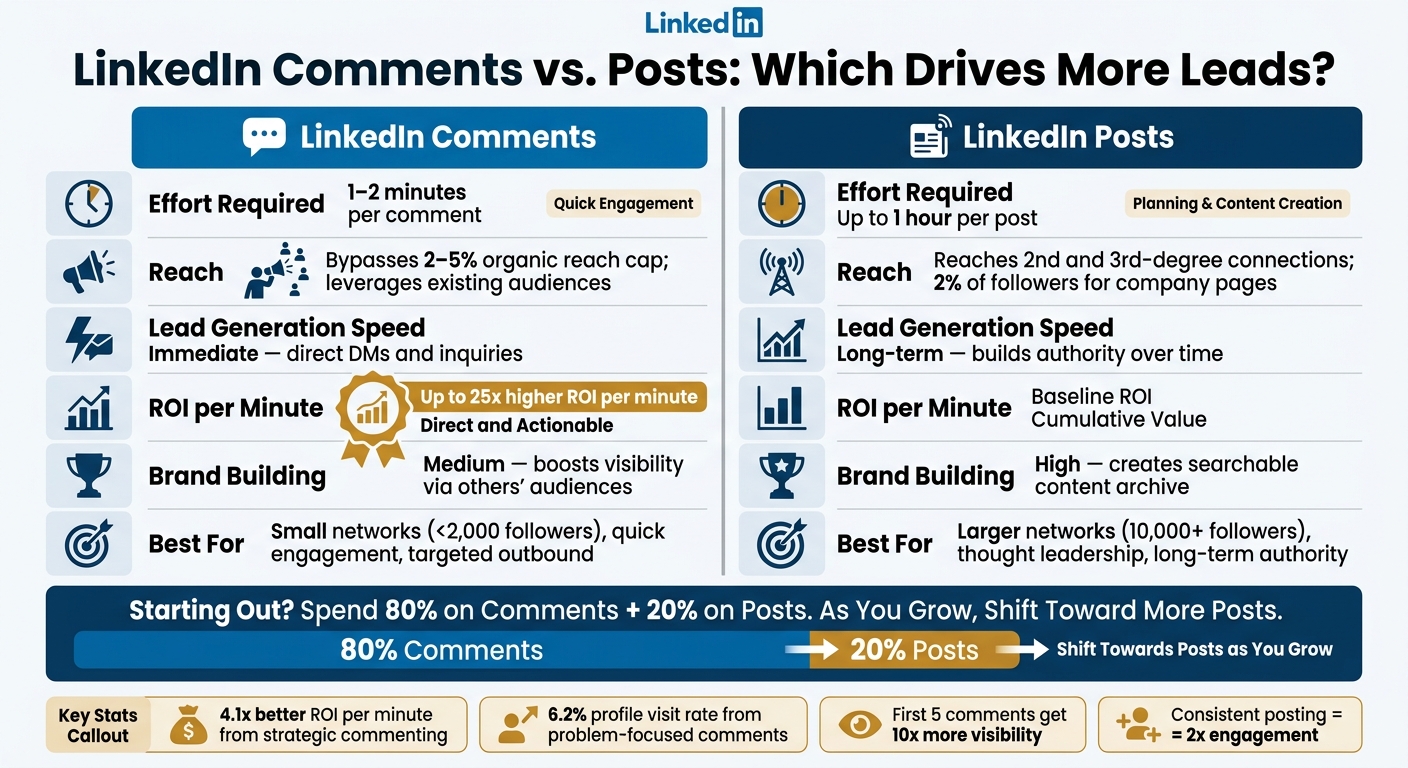
LinkedIn Comments vs. Posts: Key Metrics for Lead Generation
How LinkedIn Posts Drive Leads
What Makes LinkedIn Posts Work?
Think of a LinkedIn post as a broadcast. You share something worthwhile, the algorithm picks it up, and it lands in front of the right audience. Each post acts as a magnet, pulling attention to your profile, where potential leads can explore your expertise.
But here's the catch: the format of your post can make or break its success. Video posts generate 5x more engagement, images double the chances of getting comments, and document carousels keep people scrolling longer. These actions signal the algorithm to expand your post's reach.
The opening lines are everything. If they don’t grab attention, the rest of your post won’t matter. Short, punchy sentences and plenty of white space are essential - especially for mobile users.
Beyond the technical aspects, LinkedIn posts offer unique advantages that can amplify your efforts to generate leads.
Strengths of LinkedIn Posts for Lead Generation
One of the biggest perks of LinkedIn posts is their compounding reach. A high-performing post doesn’t just stay within your circle - it can travel to second- and third-degree networks, reaching people far beyond your immediate followers. Brands that post consistently - at least once a week - experience 2x the engagement compared to those who post sporadically.
Another hidden strength is what marketers call "category memory." Since 95% of B2B buyers aren’t actively shopping at any given time, regular posting keeps you top of mind until they’re ready to make a decision. As Ty Heath, LinkedIn’s Director of Market Engagement, explains:
"The best ads drive sales over the longest periods of time by building memories that still have the power to influence our buying decisions years later."
This long-term impact gives posts an edge over comments. Posts publicly showcase your expertise and create a lasting content archive. When someone visits your profile later, they can scroll through your posts to quickly determine if you’re someone worth contacting.
Limitations of LinkedIn Posts
That said, LinkedIn posts come with their challenges. First, they’re time-intensive. A strong post can take around an hour to craft, and organic reach for company pages has plummeted - from 7% to just 2% of followers. Personal accounts fare better, but success still depends on the size and engagement of your network. Without an audience, even the best content might not gain traction.
Consistency is another hurdle. The algorithm penalizes irregular posting, which can create a cycle where you feel forced to churn out content just to stay visible. Plus, posts have a short lifespan. Once their momentum fades - usually within a few hours - they disappear from feeds. Unlike comments, which can resurface in active discussions, posts rarely get a second wind.
"Strategy beats frequency every time. One powerful, strategic post > 30 random posts." - Insa Hafeez, LinkedIn Strategist
The key isn’t to post more often - it’s to post smarter. Focus on crafting posts with a strong hook, immediate value, and a clear call to action. That’s how you turn attention into leads.
sbb-itb-f8f3793
How LinkedIn Comments Drive Leads
Why Comments Are Getting More Attention
Engaging in comments places you right in the middle of active conversations, tapping into an already engaged audience instead of broadcasting your message to a broader, less targeted group. By leaving a thoughtful comment on someone else's post, you can effectively leverage the visibility of that post's audience. This approach is particularly useful for professionals with smaller followings - under 2,000, for example. Many are now adopting an 80/20 strategy: spending 80% of their time commenting and only 20% creating their own posts to establish authority more quickly.
"A great comment on a post with 10,000 views reaches more people than your own post that gets 200 views."
Strengths of Comments for Lead Generation
Commenting is efficient and impactful. Crafting a quality comment takes just 1–2 minutes, compared to the hour or more often required to write a full post. This efficiency allows you to participate in multiple discussions throughout your day. Plus, comments act as a great way to identify potential leads. By engaging with posts where people discuss specific challenges - like hiring struggles or revenue growth issues - you can connect with warm leads. On average, commenting on problem-focused posts results in a 1.8% client inquiry rate.
Another advantage? Comments are visible to everyone who views the original post, bypassing the 2–5% reach that standalone posts usually get. LinkedIn’s 2026 algorithm also prioritizes thoughtful comments (those with at least 15 words), giving them 15 times more weight than a simple "like" when it comes to boosting your visibility.
The results speak for themselves. Take UI/UX designer Sarah K., for instance. In early 2026, she left a concise, value-packed comment on a SaaS founder's post about onboarding challenges. She suggested simplifying a 5-step process into 3 steps, which could boost completion rates by over 30%. That quick, 30-second comment generated 1,872 impressions, 78 profile views, and eventually landed her an $8,500 redesign project. Similarly, SEO consultant Thomas committed to leaving eight targeted comments a day. This strategy led to a 140% increase in connection requests and two new three-month consulting contracts.
Tools like Postelix can make this process even easier by identifying posts that indicate buying intent and helping you draft personalized comments. This way, you can engage consistently without spending excessive time on manual outreach.
Limitations of Comments
Of course, commenting isn't without its downsides. The biggest challenge is the lack of control over the narrative. When you're commenting on someone else's post, you're essentially a guest in their discussion, which means the topic or tone can shift in ways you can't predict. There's also the risk of coming across as spammy. Generic comments like "Great post!" or "Thanks for sharing!" are often flagged by LinkedIn's algorithm as low-value engagement. Every comment you leave reflects your expertise, so it’s crucial to ensure your contributions genuinely add value to the conversation.
This breakdown sets the stage for a direct comparison with creating your own posts in the next section.
LinkedIn Posts vs. Comments: A Direct Comparison
Key Metrics Side by Side
Posts and comments on LinkedIn play different roles in lead generation, and comparing them across key dimensions highlights their unique strengths. Here's a quick look at how they stack up:
| Dimension | LinkedIn Posts | LinkedIn Comments |
|---|---|---|
| Lead Intent | Medium - creates broad awareness and nurtures inbound leads | High - focuses on targeted threads with contextual expertise |
| Scalability | High - a single post can reach a large audience | Medium - requires manual, personalized input |
| Message Depth | High - allows for detailed frameworks, stories, and data | Medium - concise, ideally 15–150 words |
| Brand Building | High - establishes authority and creates a searchable content archive | Medium - boosts visibility by leveraging others' audiences |
| Conversion Timeline | Long-term - builds relationships over time | Immediate - can lead to direct DMs and inquiries |
| ROI per Minute | Baseline | Up to 25x higher per minute invested |
Strategic commenting provides a 4.1x higher ROI per minute than posting. However, both formats shine depending on your specific objectives.
When Comments Outperform Posts
If you're looking for quick results - especially with a smaller audience - comments are your best bet. For those with fewer than 5,000 followers, posts often lack the reach to compete with a well-placed comment on a high-visibility thread. Commenting allows you to tap into an existing audience instantly.
Comments are especially effective for targeted outbound efforts. For example, responding to posts where potential clients share specific problems - like hiring challenges, stalled revenue growth, or product adoption issues - lets you position yourself as the expert they need. The results? Problem-focused comments can generate a 6.2% profile visit rate and a 1.8% client inquiry rate. This isn't just about visibility; it's about directly filling your pipeline.
"For agency owners and founders, original content is time-consuming. But a well-placed comment can yield up to 25x the ROI per minute compared to posting." - Junaid Khalid, CEO, Ertiqah.com
Timing also matters. The first five comments on a post receive 10x more visibility than those posted later. By joining high-intent conversations early, your comments can have an outsized impact.
When Posts Outperform Comments
Posts take the lead when you're aiming for long-term authority. If your goal is to establish thought leadership, share a unique perspective, or educate your audience on challenges they may not even realize they have, posts are the way to go. Unlike comments, which are tied to someone else's thread, posts live on your profile permanently, building a searchable archive of your expertise.
Posts also offer unmatched scalability. For instance, a well-designed PDF carousel can engage thousands without requiring additional effort. While comments are limited to one-on-one conversations, posts let you educate, tell stories, and build relationships on a much larger scale. They’re perfect for creating lasting impact and positioning yourself as a go-to expert in your field.
LinkedIn's New Algorithm: Why Your Comments Matter More Than Your Posts
Building a Strategy That Uses Both Posts and Comments
To generate more leads on LinkedIn, it’s essential to create a workflow that integrates both posts and comments effectively.
A Daily and Weekly Workflow for Posts and Comments
Striking the right balance between posting and commenting depends on the size of your LinkedIn audience. If you’re just starting out with fewer than 2,000 followers, dedicate about 80% of your time to commenting and the remaining 20% to creating original posts. Once you’ve grown your audience past 10,000 followers, you can shift toward focusing more on posting while still staying active in the comment sections of your own content.
Make use of the "Golden Hour": spend 15–20 minutes engaging with key posts right before publishing your own. This primes your network and signals activity to LinkedIn’s algorithm, helping your content gain traction.
Follow the 4-1-1 rule for weekly content: create four value-driven posts, one soft promotional post, and one call-to-action post. On top of this, pair each posting day with 10 targeted comments on posts from prospects, peers, or influential figures your ideal clients follow. Aim for 10–15 meaningful comments daily across a rotating list of 20–30 target accounts. Additionally, make it a habit to reply to every comment on your own posts within the first 60 minutes - this can boost your visibility by up to 35%.
"If you are only posting and not engaging on other people's content, you are leaving the easiest wins on the table." - Keith Teo, Founder, Cclarity
For those looking to save time, tools like Postelix can help streamline this process. The Chrome extension drafts contextually relevant comments and identifies high-intent threads, making it easier to stay active and focused on building your pipeline.
Once your workflow is in place, tracking your results is crucial for fine-tuning your strategy.
How to Measure What Is Working
To ensure your strategy is effective, focus on metrics that indicate lead generation rather than just surface-level activity. Pay attention to leading indicators like profile views, comment reply rates, and inbound connection requests, as opposed to vanity metrics like impressions or follower count.
| Metric | Target | Why It Matters |
|---|---|---|
| Profile Views | +20%–50% monthly | Indicates that your comments and posts are sparking curiosity. |
| Comment Reply Rate | 20%–40% | Shows that your comments are encouraging meaningful conversations. |
| Inbound Connection Requests | 5–15 per week | Demonstrates that you’re being recognized as an authority. |
| Inbound DMs | 3–5 per week | A clear sign that your efforts are contributing to pipeline growth. |
| SSI Score | 65+ | Serves as an overall indicator of your profile’s health and engagement. |
Set aside 10 minutes every Monday to log these numbers and look for trends over a four-week period. For instance, if your profile views are increasing but inbound DMs aren’t, your comments might be generating visibility but not enough curiosity. In such cases, try ending your comments with an open-ended question to encourage direct engagement.
Conclusion: Picking the Right Approach for Your Goals
Both posts and comments are essential tools for LinkedIn lead generation, but they serve different purposes. Comments are a fast track to visibility - 40% of profile appearances come from active commenting - while posts establish the credibility that turns those visitors into leads.
The numbers back this up: strategic commenting delivers a 4.1x better return on time investment compared to creating original content. At the same time, posts provide the depth and authority your profile needs to encourage meaningful connections. When used together, these approaches create a powerful synergy - far more effective than relying on one alone.
Your strategy should align with where you are in your growth journey. If you're just starting out, focus on commenting to maximize visibility. As your audience grows, shift your attention toward crafting original posts while continuing to engage in discussions. Keep an eye on metrics like profile views, inbound messages, and connection requests to measure your progress.
Feeling stretched thin? Tools like Postelix can simplify the process. It helps you identify high-value threads to engage with, drafts comments in your voice, and assists in creating original posts - all while saving you hours each week. Start fine-tuning your LinkedIn activity today and watch your lead generation efforts take off.
FAQs
How do I find the right posts to comment on for leads?
Zero in on posts from your ideal customer profile (ICP) that bring up challenges or pain points they’re facing. These posts often offer a window into their needs and priorities. Pay extra attention to posts that are trending or have high engagement - these tend to amplify visibility and can position you in front of a larger audience.
When interacting, leave thoughtful, meaningful comments. Share insights, provide helpful perspectives, or pose open-ended questions that encourage further discussion. It’s not just about being seen; it’s about adding value and building connections.
And here’s a tip: timing is everything. Engaging within the first hour of a post going live can significantly boost your chances of connecting with potential leads and sparking meaningful conversations.
What should I write in a comment to avoid sounding spammy?
To steer clear of sounding spammy on LinkedIn, aim to leave thoughtful, authentic, and relevant comments that contribute to the discussion. Engage with specific points from the post, share your own perspective, or ask meaningful questions. Skip generic compliments or vague comments - they don’t add much to the conversation. Instead, focus on crafting comments that are more than 10 words long. Longer responses often come across as more sincere and show genuine interest, helping you build credibility through purposeful interaction.
How do I turn profile views into DMs and sales calls?
To transform LinkedIn profile views into direct messages and sales calls, it’s all about strategic engagement. Start by leaving thoughtful comments on posts from your target audience. Focus on addressing their challenges or pain points - this builds both visibility and credibility.
Once you've established a connection, follow up with personalized DMs. Voice notes can be especially effective for creating a sense of trust and authenticity.
To streamline this process, tools like Postelix can help you pinpoint warm leads and craft impactful comments, making it easier to turn profile visits into meaningful conversations and, ultimately, sales opportunities.