
AI is transforming LinkedIn sales funnels by automating repetitive tasks, personalizing outreach, and identifying high-potential leads with intent signals. Here's how it enhances every stage of the funnel:
- Awareness: AI helps optimize profiles and post angles to attract more views and engagement.
- Engagement: Tailored connection requests and messages crafted with AI see up to 40% higher acceptance rates.
- Conversion: AI tracks behavioral signals like profile visits and content interactions to prioritize warm leads, improving reply rates and deal closures.
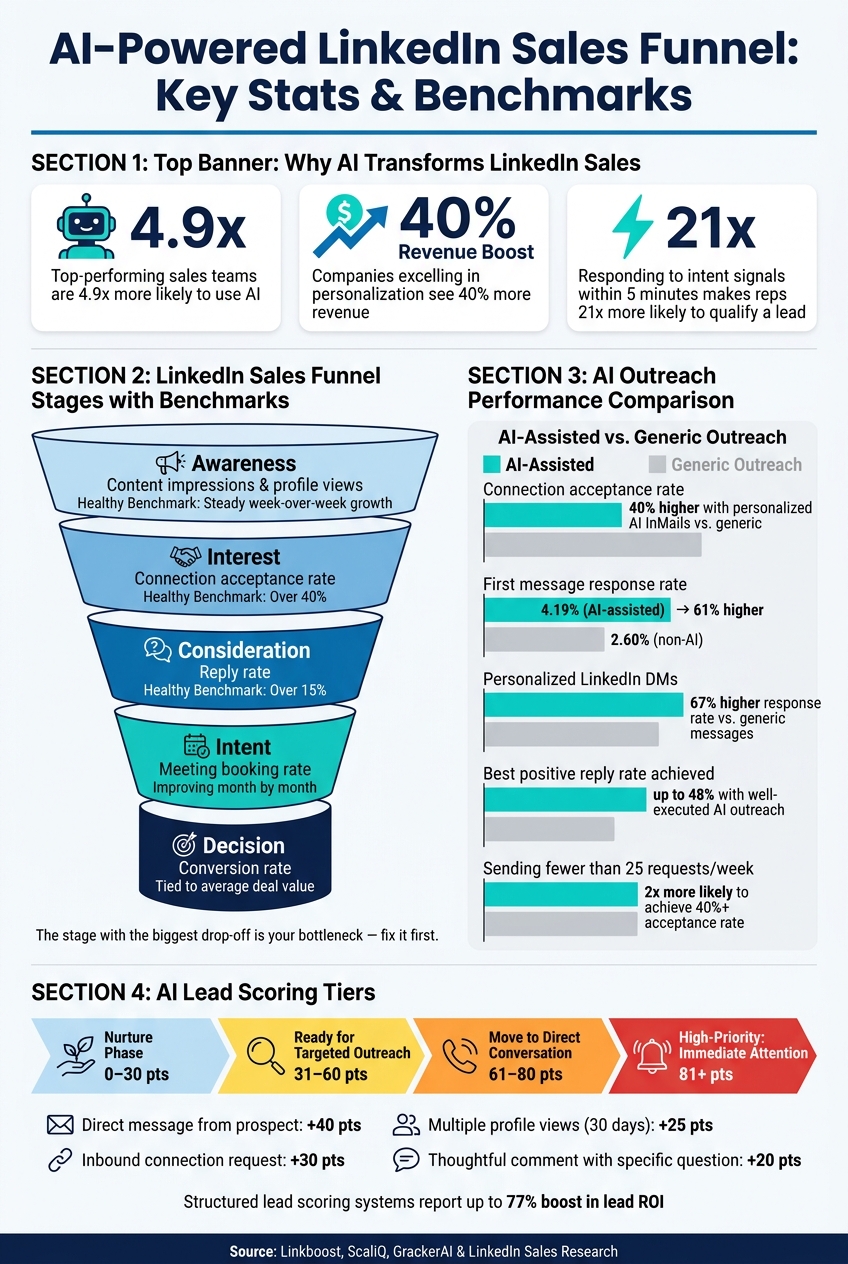
AI-Powered LinkedIn Sales Funnel: Key Stats & Benchmarks
How to Map and Improve Your LinkedIn Sales Funnel
Before diving into AI tools, it’s crucial to first map out your current LinkedIn sales funnel. Skipping this step and jumping straight into automation often leads to wasted efforts. Automation can’t fix underlying issues - it only amplifies what’s already there. By laying a solid data foundation, you’ll set the stage for AI to truly enhance your funnel.
Breaking Down Each Funnel Stage
A LinkedIn sales funnel flows through five main stages: content impressions (how many people see your posts), profile views (who checks out your profile), connection requests (who you’re reaching out to and who accepts), first-touch conversations (initial messages), and qualified opportunities (prospects who are ready to buy).
Each stage naturally feeds into the next. For example, if you’re getting plenty of profile views but very few connection acceptances, the issue likely lies with your profile or outreach message - not your targeting. Pinpointing which stage is underperforming prevents misdirected fixes.
How to Measure Your Funnel's Current Performance
LinkedIn’s built-in analytics provide data on content impressions and engagement. However, for metrics beyond that - like acceptance rates, reply rates, and meeting bookings - you’ll need a CRM or a specialized sales tool to track these numbers consistently.
Here’s a quick guide to the key metrics and healthy benchmarks for each funnel stage:
| Funnel Stage | Metric to Track | Healthy Benchmark |
|---|---|---|
| Awareness | Content impressions & profile views | Steady week-over-week growth |
| Interest | Connection acceptance rate | Over 40% |
| Consideration | Reply rate | Over 15% |
| Intent | Meeting booking rate | Improving month by month |
| Decision | Conversion rate | Tied to average deal value |
For instance, if your connection acceptance rate is below 20%, it’s a sign that either your targeting or outreach copy needs improvement - not that you should send more requests. In fact, sales reps who send fewer than 25 connection requests per week are almost twice as likely to achieve acceptance rates above 40% compared to those who send in bulk.
By understanding your current metrics, you can zero in on areas that need attention.
How to Find Bottlenecks and Fix Them First
To identify bottlenecks, compare your metrics against the benchmarks above. The stage with the biggest drop-off is your bottleneck - and that’s where AI can make the most immediate impact.
"The 'spray and pray' era of B2B sales is officially dead... sending 100 connection requests a week doesn't guarantee a full pipeline - it guarantees algorithmic penalties." - Linkboost
If your reply rate is low (below 15%) but your connection acceptance rate is strong, the issue lies in your messaging. AI can help by analyzing a prospect’s recent activity - like posts, job changes, or company updates - to craft personalized messages that resonate. On the other hand, if your acceptance rate is poor, AI can refine your targeting by focusing on behavioral signals, such as prospects engaging with content related to your solution, instead of relying solely on job titles or locations.
sbb-itb-f8f3793
How to Find and Warm Up the Right Leads Using AI
Once you've tackled funnel leakage, the next step is warming up high-quality leads to improve every stage of your LinkedIn sales funnel. This is where AI can make a real difference.
How AI Identifies Warm Leads and Buying Signals
AI excels at spotting behavioral patterns that indicate when a prospect is ready to buy. For instance, if someone revisits your profile multiple times or spends time reading a case study in your Featured section, these actions signal strong interest. AI aggregates these subtle behaviors into an intent score, helping you identify which prospects are most likely to convert.
External events can also reveal buying intent. Funding announcements, leadership changes, or even a hiring surge - like a company onboarding several SDRs - can hint at major investments in sales infrastructure. Job changes are another powerful indicator. Prospects who’ve started new roles in the past 90 days convert 3–4x more often than average leads, often because they have fresh budget authority and a mandate to make changes.
| Intent Signal | What It Looks Like | Recommended Action |
|---|---|---|
| Strong | Pricing inquiries, demo requests, direct technical questions | Respond the same day |
| Medium | Repeated profile visits, case study engagement, comments on competitor posts | Reach out within 24–48 hours |
| Weak | Single post like, following a company page, webinar signup | Monitor for additional signals before acting |
Data source:
Timing is everything. Responding to intent signals within 5 minutes makes a rep 21x more likely to qualify a lead.
Armed with this data, you can create content that resonates with warm leads and boosts engagement.
How to Use AI to Create Personalized LinkedIn Content
Take an inbound-led approach: publish valuable content that draws in engaged prospects, then use behavioral data to pinpoint the most interested individuals for personalized follow-up. Instead of cold-pitching strangers, your outreach connects with people who’ve already shown interest.
"The definition of personalization has shifted from 'accuracy' to 'relevance.'" - Linkboost
AI tools can analyze a prospect’s recent activity, tone, and language to help you craft messages that address their specific challenges. Personalized InMails achieve 40% higher acceptance rates than generic ones, and AI-assisted first messages see a 61% higher response rate (4.19% vs. 2.60%).
Before sending a direct message, try using AI to draft a few targeted comments on a prospect’s posts. This “pre-warming” tactic builds familiarity and positions you as a peer rather than just another salesperson.
By integrating these strategies, you can turn insights into action and generate leads that are primed for conversion.
How Postelix Supports Lead Generation
Postelix is designed to streamline this entire process. Its intent-based lead discovery feature identifies LinkedIn prospects showing buying signals by analyzing their behavior, such as how often they revisit your profile or engage with your content.
For content creation, Postelix offers personalized tone generation, ensuring your LinkedIn posts sound like you rather than a generic template. You can upload up to 30 documents on the Pipeline plan to provide context, allowing every post to reflect your expertise and address your audience’s pain points. The platform also handles scheduling and consistency, so you don’t have to worry about daily posting.
The Pipeline plan goes even further with a 24/7 Hot Lead Agent. This tool monitors up to 10 competitor accounts and tracks 10 intent keywords, delivering 25–50 high-intent leads daily with advanced scoring. By the time you’re ready to reach out, you’ll already have a list of prospects who are primed to buy - helping you close deals faster and more effectively across your sales funnel.
How to Engage and Qualify Prospects at Scale with AI
Once you've identified warm leads, AI can step in to engage them consistently, taking over repetitive tasks while still maintaining a personal, human-like touch.
How AI Handles LinkedIn Comments and Conversations
Interacting with a prospect’s LinkedIn posts is a great way to build rapport, but doing this manually at scale is nearly impossible. AI tools simplify this process by analyzing the context and tone of a post, then taking actions like scheduling a profile visit or flagging the lead for further outreach.
"In 2026, the winners are not the ones with the biggest automation scripts, but the ones with the strongest signals of trust." - Linkboost
To stay within LinkedIn’s behavioral norms and avoid account restrictions, it’s recommended to limit automated actions - such as profile views, connection requests, and comments - to 30–50 per day. Adding randomized delays to these actions helps keep them natural. This setup creates a foundation for more personalized messaging, which we’ll dive into next.
How to Use AI to Write Personalized LinkedIn DMs
Once you’ve warmed up a lead, the next step is crafting personalized direct messages. By 2026, buyers are expected to be even more wary of generic, templated messages. Instead of just swapping in a first name, focus on using meaningful data points like the prospect’s role, industry, or a recent post to create a tailored and context-rich opening.
A helpful framework for writing these messages is the 4-Point approach:
- Hook: Reference something specific about the prospect.
- Context: Explain why you’re reaching out.
- Value: Highlight what’s in it for them.
- CTA: End with a simple, low-pressure call to action.
To keep the tone conversational, aim for messages under 60 words. This makes them feel more like a quick chat than a formal email.
AI tools can also categorize responses into types like "Interested", "Not Now", "Question", or "Objection." Based on the reply, follow-up sequences can automatically adjust - for example, ensuring that a clarifying question is answered directly rather than triggering a generic follow-up. This approach works: personalized LinkedIn messages see a 67% higher response rate compared to generic ones, and well-executed outreach can result in positive reply rates as high as 48%.
| Follow-up Type | Recommended Length | Key Objective |
|---|---|---|
| Short Polite Nudge | ≤ 55 words | Reconnect if your message got buried; offer an easy way to opt out. |
| Meeting Ask | 60–90 words | Suggest a 15–20 minute meeting; include a booking link and two time options. |
| Value-Add | 70–110 words | Share a resource linked to the prospect’s recent post or interest. |
| Answer Clarifier | 60–100 words | Directly address a prospect’s question and ask for clarification if needed. |
Postelix Tools for Engagement and Lead Qualification
To streamline these AI-driven strategies, Postelix provides a suite of tools designed to optimize your outreach. The DM Writer Assistant, available with Growth and Pipeline plans, helps craft personalized LinkedIn messages by analyzing a prospect’s activity and aligning the tone with your existing content.
Their Chrome extension allows you to engage directly on LinkedIn without switching tabs, making it easy to comment on posts and manage conversations in real time. For deeper lead qualification, Postelix’s advanced lead scoring - part of the Pipeline plan - prioritizes prospects based on behavioral signals, not just job titles. This ensures your team focuses on leads with the highest potential to convert, creating a seamless journey from initial contact to closing the deal.
How to Use AI Insights to Scale Your LinkedIn Sales Funnel
Once your outreach is up and running, the real power lies in leveraging data insights to refine your strategy.
How AI Tracks Engagement and Scores Leads
Many sales professionals stick to tracking basic metrics like post likes or profile views, but AI takes it several steps further. It identifies behavioral patterns - sequences of actions that reveal genuine buying intent. For example, a prospect who views your profile, clicks on a case study, and revisits within 48 hours is far more engaged than someone who simply likes a post.
AI assigns weighted scores to different engagement signals. Here’s how it might work:
- A direct message from a prospect: +40 points
- An inbound connection request: +30 points
- Multiple profile views within 30 days: +25 points
- A thoughtful comment with a specific question (e.g., "Does this work for enterprise teams?"): +20 points
Using these scores, leads are categorized into tiers:
- 0–30 points: Nurture phase
- 31–60 points: Ready for targeted outreach
- 61–80 points: Move to direct conversation
- 81+ points: High-priority leads needing immediate attention
AI also applies a time-based decay to ensure inactive leads don’t clutter your pipeline. Companies using such structured lead scoring systems report up to a 77% boost in lead ROI. This setup makes it easy to know exactly when to step in and engage personally.
When to Use AI and When to Step In Personally
AI is perfect for handling repetitive tasks - filtering out spam, recruiters, and irrelevant connections - while keeping a constant eye on engagement signals. But once a lead crosses the "hot" threshold or sends a message with a complex question, like pricing details or technical concerns, it’s time for you to step in.
Quick human responses are critical when a lead is ready to convert. Instead of replacing your role, AI ensures that you’re only involved when it matters most, letting you focus on closing deals.
"Engagement data gets you in the room; conversational data gets you the deal." - ScaliQ
This balance between AI and human input is key to optimizing your sales funnel.
How Postelix Supports Ongoing Funnel Improvement
To turn AI-driven insights into actionable results, Postelix, a Taplio alternative built for intent-led growth, offers tools that keep your sales funnel running smoothly. Its 24/7 Hot Lead Agent, available with the Pipeline plan, monitors LinkedIn for intent signals and flags leads as soon as they meet your criteria. Unlike basic job title filters, Postelix’s lead scoring system weighs behavioral signals to highlight prospects most likely to convert.
The Pipeline plan also tracks up to 10 intent keywords and 10 competitor accounts, delivering a live stream of 25–50 intent-qualified leads daily. With CSV export functionality, integrating these leads into your CRM is effortless - no manual data entry required. The result? A sales funnel that doesn’t just generate activity but consistently identifies the right opportunities at the right time.
Conclusion: Using AI to Get More Out of Your LinkedIn Sales Funnel
AI isn't just about speeding up LinkedIn outreach - it’s about making it smarter. This guide has shown how AI can elevate every step of your LinkedIn sales funnel: from pinpointing the right prospects to crafting tailored messages at scale, automating interactions, and accurately scoring leads based on genuine buying signals instead of guesswork.
The data speaks for itself. Top-performing sales teams are 4.9 times more likely to use AI compared to those that lag behind. AI-driven first messages boast a 4.19% response rate, significantly outpacing the 2.60% rate of non-AI messages. Companies that excel in personalization see a 40% revenue boost from those efforts compared to their peers. These aren’t small improvements - they can transform a sluggish pipeline into one brimming with consistent opportunities.
The key lies in adopting a Human-in-the-Loop model. Let AI handle tasks like research, lead scoring, and drafting, while you focus on high-stakes conversations and tackling complex objections. As Ankit Agarwal, Head of Marketing at GrackerAI, aptly puts it:
"The future of LinkedIn outreach isn't AI or human. It's AI-enhanced human connection."
If you’re ready to take these strategies to the next level, tools like Postelix combine these capabilities into a single platform. With features like intent-based lead discovery, voice-personalized messaging, and a 24/7 Hot Lead Agent that highlights your top prospects before the competition, Postelix helps turn LinkedIn efforts into meaningful business conversations - whether you’re building from scratch or scaling an established pipeline.
FAQs
What should I track to find my biggest funnel bottleneck on LinkedIn?
To spot issues in your LinkedIn sales funnel, focus on tracking essential metrics such as connection request acceptance rates, message response rates, and meeting booking rates. It's also important to keep an eye on top-of-funnel activity - if your content isn't getting enough visibility, it will be tough to see results further down the line. Tools like Postelix can be incredibly helpful here, offering intent-based lead discovery and ensuring consistent engagement. This way, you can keep your pipeline active and measurable.
How can AI identify which LinkedIn leads are actually 'warm'?
AI identifies warm leads by examining behavioral patterns and engagement signals that go beyond simple metrics like profile views. For example, tools like Postelix track actions such as detailed comments or sudden increases in activity, which often signal strong interest. AI scoring models then rank these leads by analyzing factors like engagement quality, relevant company information, and timing. This ensures your attention is directed toward prospects showing genuine and timely interest.
How do I use AI without risking LinkedIn limits or restrictions?
To steer clear of LinkedIn restrictions, it's crucial to prioritize natural behavior and meaningful engagement. LinkedIn relies on a dynamic Trust Score that evaluates your activity and profile history.
Steer away from automated behaviors, such as sending messages at exact intervals or using repetitive templates. Instead, vary your activity timing, align it with local working hours, and use residential IP addresses. Gradually ramp up your activity over a three-week period to maintain a natural pattern. Tools like Postelix can assist by creating tailored content and encouraging genuine interactions, helping you improve your Trust Score while staying within LinkedIn's guidelines.